

4th Project Steering Committee Sustains Momentum for Aquatic Biodiversity Conservation
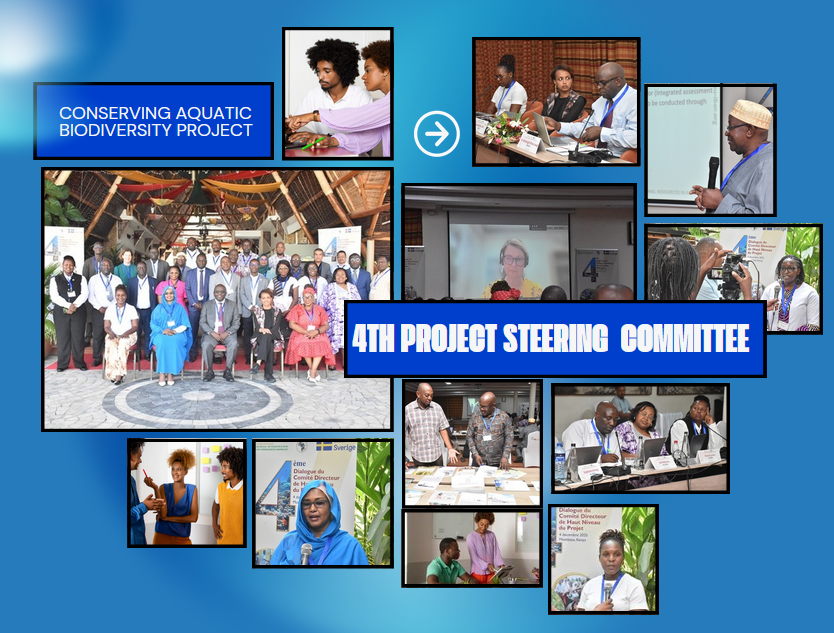
Africa’s effort to conserve aquatic biodiversity is steadily shifting from project-based interventions to long-term systems change. Read about this change. This transition was strongly reinforced through the recent deliberations of the Project Steering Committee (PSC) of the Conserving Aquatic Biodiversity in the Africa Blue Economy Project, implemented by AU-IBAR with support from the Swedish International Development Cooperation Agency (Sida).
Across ecosystems, institutions, and communities, the Project is increasingly recognised as a continental platform that links policy, science, and local action. Steering Committee members affirmed that aquatic biodiversity is no longer viewed solely as an environmental issue but as a strategic foundation for food security, climate resilience, livelihoods, and the transformation of Africa’s Blue Economy.
From Protection to Productive Conservation
Deliberations underscored the importance of moving beyond isolated conservation actions toward integrated, value-driven approaches. Countries and regions highlighted progress in restoring degraded habitats, strengthening co-managed conservation areas, and embedding biodiversity into fisheries and aquaculture value chains. There was broad consensus that ecosystem protection must now be paired with economic valuation of blue resources to strengthen political commitment and unlock sustainable financing.
The PSC further reinforced that nature-based solutions, ecosystem valuation, and climate adaptation must become core pillars of future interventions—especially in transboundary waters where ecological risks and economic dependencies intersect.
Governance, Data and Regional Cooperation as Enablers
A clear message emerged that governance and data systems are now central to conservation success. The Project’s investments in regional cooperation, marine protected area governance, and Monitoring, Control and Surveillance (MCS) systems were acknowledged as critical to combating illegal, unreported and unregulated (IUU) fishing and safeguarding shared aquatic resources.
The Steering Committee emphasized the growing role of digital platforms and harmonised data systems, including continent-wide biodiversity information tools, as enablers of evidence-based decision-making. Strengthening national and regional capacity for data collection, interpretation, and reporting was identified as essential for sustaining impact beyond project timelines.
Inclusion, Youth and Gender as Drivers of Sustainability
The PSC placed strong emphasis on the central role of women and youth in shaping the future of aquatic biodiversity governance. Women’s participation across fisheries value chains and youth-led conservation enterprises were recognised not as side components, but as key drivers of resilience, innovation, and social legitimacy. Future interventions are expected to deepen gender-responsive governance while scaling youth- and private sector-led initiatives in conservation and value addition.
Strategic Direction and Key Recommendations
To consolidate gains and guide the next phase of continental action, the Steering Committee advanced several strategic priorities:
- Advance ecosystem and blue value chain valuation across fisheries, aquaculture, and aquatic ecosystems to strengthen investment and policy decisions.
- Strengthen governance of marine protected areas and community-managed conservation zones, including Other Effective Conservation Measures (OECMs).
- Sustain and expand regional MCS cooperation to secure aquatic ecosystems and regional fish trade.
- Scale nature-based solutions and climate-responsive interventions in aquatic systems.
- Embed digital innovation and scientific excellence at the heart of biodiversity governance.
- Elevate the participation of women, youth, and the private sector as long-term custodians and investors in aquatic biodiversity.
- Institutionalise knowledge-sharing mechanisms, including a continental knowledge fair for wider dissemination of good practices and lessons.
Looking Ahead: A Platform for Long-Term Transformation
Rather than closing a phase, the PSC reaffirmed the Project’s role as a living continental framework for aquatic biodiversity governance. With preparations underway for the next phase and an Exit and Sustainability Strategy being finalised, the Project is transitioning toward durable institutional anchorage, regional integration, and scalable impact.
As Africa accelerates implementation of its Blue Economy agenda under Agenda 2063, the Conserving Aquatic Biodiversity Project is steadily evolving into a continental backbone for policy coherence, scientific cooperation, community stewardship, and climate-resilient growth, ensuring that Africa’s rivers, lakes, wetlands, and oceans continue to sustain both people and prosperity.