

Le Togo approuve son Plan stratégique national de lutte contre la peste des petits ruminants (PPR) 2025-2030 : un engagement renouvelé pour éradiquer la peste des petits ruminants d'ici 2030
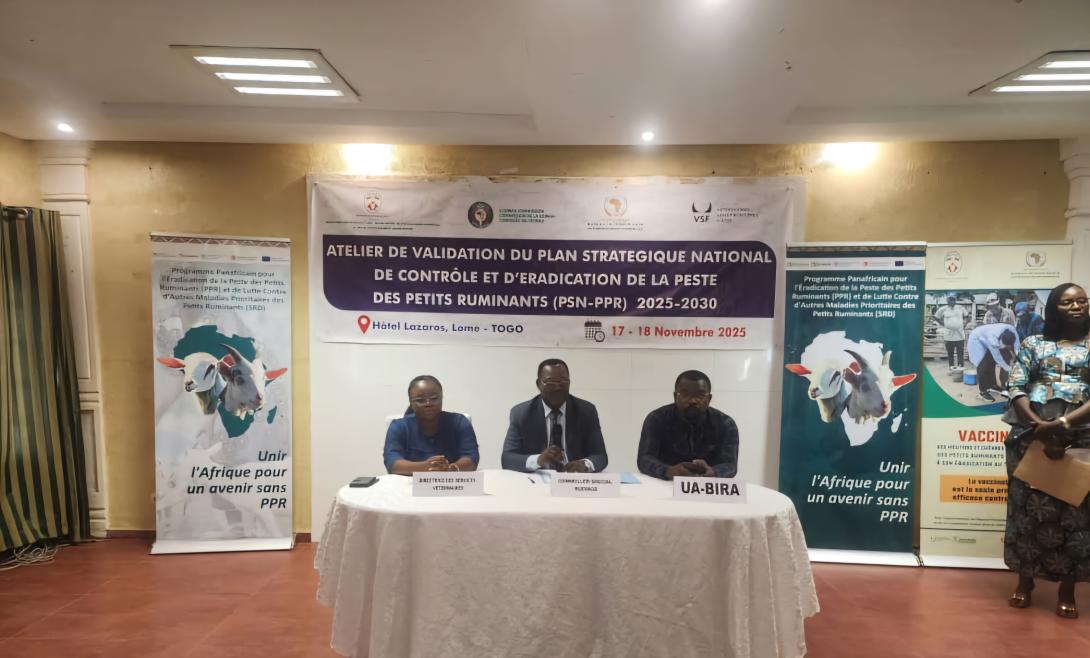
Le Togo a renforcé sa dynamique nationale en faveur de l'éradication de la PPR les 17 et 18 novembre 2025 en validant officiellement son Plan stratégique national (PSN) 2025-2030 lors d'un atelier de haut niveau à Lomé.
Organisé à l'Hôtel Saint LAZAROS à Lomé, l'atelier national a réuni plus de quarante participants issus des services vétérinaires, d'organisations d'éleveurs, d'instituts de recherche et de partenaires techniques et financiers, notamment la FAO, la CEDEAO-RAHC, l'OMSA et l'UA-BIRA.
S'exprimant lors de la cérémonie d'ouverture, la directrice des services vétérinaires (DVS) a souligné l'importance stratégique de la lutte contre la PPR pour le secteur de l'élevage au Togo. Elle a insisté sur le fait que la lutte efficace contre cette maladie hautement contagieuse est essentielle pour la sécurité alimentaire, la résilience économique et la réduction de la pauvreté dans les zones rurales.
Elle a souligné la nécessité d'un plan solide et doté de ressources suffisantes, capable d'améliorer la productivité du secteur des petits ruminants, un atout économique essentiel pour des millions de ménages togolais.
Le conseiller spécial pour l'élevage auprès du ministre de l'Agriculture a fait écho à cette ambition, rappelant que le Togo reste fermement engagé à atteindre le statut indemne de PPR d'ici 2030, conformément aux objectifs régionaux et continentaux.
S'exprimant au nom du directeur de l'AU-IBAR, le Dr Huyam Salih, le Dr Jean Marc Feussom, coordinateur continental de la PPR, a délivré un message fort soulignant :
• l'importance économique des petits ruminants, qui représentent 30 % de la valeur ajoutée du sous-secteur de l'élevage,
• la forte dépendance des ménages ruraux à l'égard des chèvres et des moutons,
• et les pertes économiques importantes causées par la PPR, avec 50 à 100 foyers signalés chaque année et des pertes estimées entre 1 et 1,5 milliard de FCFA.
Il a souligné la nécessité pour le NSP-PPR d'être opérationnel, réaliste, correctement financé et pleinement aligné sur : l'Agenda 2063, le LiDeSA (2015-2035), la stratégie mondiale de la FAO-OMSA pour l'éradication de la PPR et le programme panafricain d'éradication de la PPR (PAPS) financé par l'UE.
L'UA-BIRA a également réaffirmé son engagement à soutenir le Togo dans le renforcement de la surveillance (REMATO), l'amélioration des capacités de diagnostic, l'amélioration des campagnes de vaccination, l'amélioration de la communication et le renforcement des structures de gouvernance au sein du PSN.
Sur la base de la structure régionale en six chapitres approuvée par la CEDEAO et l'UA-BIRA, le plan stratégique national a été examiné en détail par trois groupes de travail thématiques axés sur :
• l'épidémiologie, le diagnostic et les capacités des services vétérinaires,
• le cadre stratégique et le plan d'action,
• la budgétisation, les modalités de mise en œuvre, ainsi que le suivi et l'évaluation.
Les sessions de travail ont permis aux participants :
• de réviser le contenu technique du plan,
• d'affiner les priorités en matière de surveillance, de vaccination et de laboratoires,
• de mettre à jour les estimations et les projections de coûts,
• et de consolider une feuille de route réaliste alignée sur les normes régionales et continentales.
L'approche participative a garanti une forte appropriation nationale, en impliquant à la fois les institutions centrales et les représentants des chaînes de valeur ovine et caprine.
Le NSP-PPR 2025-2030 du Togo est pleinement aligné sur :
• la Stratégie mondiale d'éradication de la PPR (GCES),
• la Stratégie panafricaine de lutte et d'éradication de la PPR,
• le Programme panafricain d'éradication de la PPR (2023-2027) coordonné par l'UA-BIRA, et les engagements régionaux de la CEDEAO.
Le plan prévoit un renforcement progressif de la surveillance et une intensification des campagnes de vaccination jusqu'en 2027, suivis d'une transition vers la vérification de l'absence de circulation virale en 2028-2029. Le Togo vise à soumettre sa demande de statut indemne de PPR à l'OMSA d'ici 2031-2032.
La validation du Plan stratégique national de lutte contre la PPR, dont le coût a été estimé, marque un tournant important pour le Togo :
- un document consolidé et techniquement solide,
- une feuille de route claire, réaliste et opérationnelle,
- un engagement politique renouvelé et un engagement renforcé de la part des multiples parties prenantes.
Comme l'a souligné l'UA-BIRA, le succès dépendra désormais :
• d'un leadership gouvernemental soutenu,
• d'une mise en œuvre de haute qualité sur le terrain,
• d'une mobilisation efficace des ressources et de l'inclusion des femmes, des jeunes et du secteur vétérinaire privé.
Avec cette étape importante, le Togo avance résolument vers la vision continentale commune : une Afrique indemne de PPR d'ici 2030.