

APMD webinar 2026 series- Building efficient livestock market ecosystem in Africa's pastoral regions
Based on the consumption of livestock and livestock products, production and tradeable market segments, Africa’s livestock sector offers an estimated total addressable market (TAM) of USD 90B annually with an indicative consumption of 25M tonnes of meat annually and a projection of 5.4% CAGR from 2024-2030.
However, the serviceable available market (SAM), which reflects the realistically served market through structured, market-oriented systems, is estimated to be at USD 35M annually. The share of SAM that can be captured by scalable, structured market systems and investments offers a serviceable obtainable market (SOM) of about USD 10B annually.
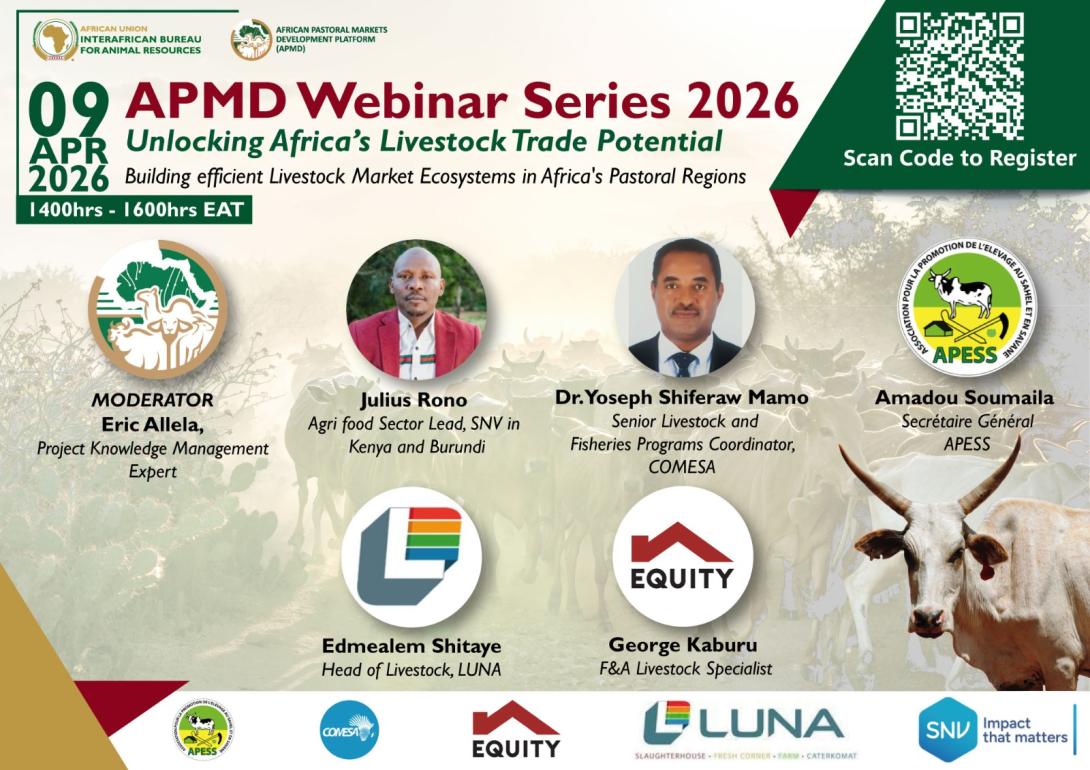
Based on this empirical market size data, the African Pastoral Markets Development (APMD) Platform, sought to address the need to build efficient and integrated livestock marketing systems to fully unlock the livestock trade potential in Africa through its Webinar 2026 series — Unlocking Africa’s Livestock Trade Potential.
The inaugural webinar highlighted the critical building blocks required to unlock Africa’s livestock trade potential. Common Market for Eastern and Southern Africa (COMESA) outlined ongoing trade policy reforms and regional frameworks aimed at facilitating cross-border livestock trade, including efforts toward harmonization of standards and reduction of non-tariff barriers.
From a private sector perspective, market actors such as LUNA and Livemore demonstrated how targeted business models are addressing specific market failures, particularly in aggregation, market access, and price inefficiencies, thereby improving the structure and performance of livestock value chains.
On financing, SNV Netherlands Development Organization and Equity Bank emphasized the importance of tailored financial instruments, risk-sharing mechanisms, and blended finance approaches in unlocking capital. They also underscored growing investment signals within the sector, reinforcing that livestock is increasingly bankable when supported by structured models, reliable off-take, and de-risked value chains.
Key investor takeaways
- Bankability is improving with the livestock sector transitioning from a perceived high-risk sector to an investible asset class, especially with structured models and financing mechanisms.
- Market failures offer opportunities to investors. For instance, gaps in aggregation, logistics and market access are not constraints, rather entry points for scalable business models.
- Regional efforts, e.g. the COMESA framework, are reducing trade friction and expanding market access, improving investment viability.
- Blended finance, guarantees and tailored lending products are critical in crowding in private capital.
- Systemic focus is as critical as production, with the highest return lying in market integration, trade facilitation and value chain structuring.
- Livestock offers immediate scale potential and not speculative demand creation, thus offering a clear growth trajectory.
At the same time, the webinar proved a clear first-mover advantage for investors willing to engage in the formalization and integration of fragmented pastoral systems. High-potential entry points included livestock aggregation models, cross-border trade corridors, financing and insurance platforms, and cold-chain and logistics infrastructure.
Returns in this sector depend less on primary production and more on the ability to structure and de-risk value chains. This includes deploying appropriate financial instruments, ensuring reliable off-take markets, investing in enabling infrastructure, and aligning with evolving policy and trade frameworks. Investors who prioritize scaling proven, bankable models, rather than pursuing fragmented or purely greenfield approaches, are more likely to achieve sustainable returns.