

Strengthening Institutional Synergy for Africa’s Blue Economy: AU-IBAR Hosts Strategic Internal Coordination Meeting in Nairobi
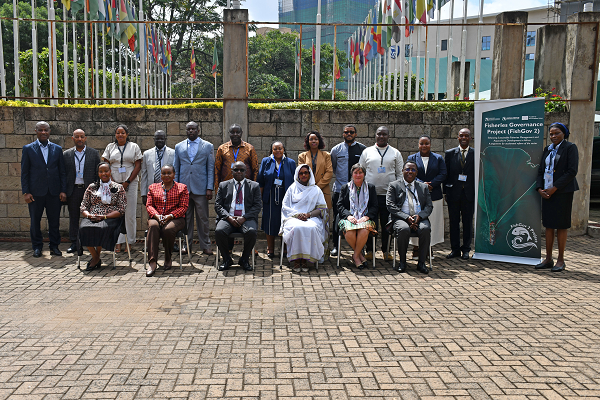
From 22–24 April 2026, the African Union Inter-African Bureau for Animal Resources (AU-IBAR) convened the 3rd Internal Coordination Meeting of African Union Commission (AUC) Departments in Nairobi, Kenya, under the Fisheries Governance Project Phase 2 (FishGov-2), funded by the European Union. The meeting brought together key AUC departments, AUDA-NEPAD, the Government of Kenya, and development partners to deepen coordination, align mandates, and accelerate delivery of sustainable fisheries and aquaculture outcomes across the continent.
A Meeting Anchored in Coordination, Delivery, and Impact
The meeting was designed to move beyond dialogue toward institutional coherence and coordinated implementation. Its overarching objective was to strengthen mechanisms for mainstreaming fisheries and aquaculture into AU policies, frameworks, and development agendas.
Specifically, the meeting aimed to:
- Share ongoing and planned initiatives across AUC departments
- Map and align fisheries-related programmes and interventions
- Review progress from previous coordination efforts
- Finalise a functional framework for sustained internal coordination
As reflected in the agenda, discussions spanned policy frameworks, blue economy strategies, ongoing programmes, and interdepartmental coordination mechanisms—highlighting the multi-sectoral nature of fisheries governance.
Strategic Messages from Leadership
AU-IBAR Director: Coordination as the Backbone of Delivery
Opening the meeting, Dr. Huyam Salih, Director of AU-IBAR, underscored that coordination is not procedural—but strategic:
“Coordination is not a procedural formality—it is the backbone of sound programme delivery. It is what transforms individual institutional efforts into a coherent continental programme.”
She emphasized that as FishGov-2 approaches its final phase, institutions must:
- Move from reporting to ownership of results
- Ensure sustainability beyond project cycles
- Strengthen documentation and dissemination of knowledge products
- Identify financing pathways to sustain outcomes
Her message reinforced a central principle: the real measure of success lies in what endures beyond the project lifecycle.
AUC (DARBE): Coordination as a Strategic Imperative
Representing the AU Commissioner for Agriculture, Rural Development, Blue Economy and Sustainable Environment, Dr. Janet Edeme highlighted the urgency of breaking institutional silos and strengthening coordination across AUC structures:
“In this era, we cannot afford to work in isolation or in silos and expect to achieve our goals. Coordination is essential to align mandates, minimize duplication, and ensure efficient use of resources.”
She underscored that the diversity of mandates across AUC departments requires deliberate and sustained coordination, anchored in five key pillars:
- Continuous mapping of departmental mandates
- Identification of opportunities for synergy and joint implementation
- Strengthened knowledge sharing and joint dissemination
- Regular engagement through focal points and coordination platforms
- Continuous capacity building across departments
Dr. Edeme further emphasised that the meeting provides a critical platform to:
“Interact, learn from one another, and identify future areas of collaboration to support alignment and mainstream fisheries and aquaculture within AU policies and initiatives.”
Her remarks positioned coordination not just as an operational necessity, but as a strategic enabler of continental policy coherence and impact.
Government of Kenya: From Reflection to Strategic Guidance
Representing the Government of Kenya, Mr. Joseph Mahongah, Director of Fisheries and Aquaculture, highlighted the importance of the meeting as a platform for reflection and forward planning:
“This meeting provides an opportunity to reflect on implementation progress, share lessons, and guide the strategic mainstreaming of fisheries across AU programmes.”
He reaffirmed Kenya’s commitment to advancing Africa’s blue economy agenda and recognized AU-IBAR’s leadership in strengthening governance through frameworks such as the Policy Framework and Reform Strategy (PFRS).
European Union: Scaling Investment and Partnership for Impact
The European Union reaffirmed its strong partnership with the African Union in advancing sustainable fisheries and ocean governance, emphasizing the need to move from policy to investment:
“We must move from policy frameworks to investment—scaling up through innovative financing and mobilizing private sector engagement to build resilient and sustainable blue economies.”
The EU highlighted:
- Its Global Gateway investment approach
- Support to regional blue economy programmes
- The importance of blended finance and private sector mobilization
- The need for scalable, bankable interventions
This reflects a broader shift toward financing-driven transformation of the fisheries and aquaculture sector.
Key Outcomes of the Meeting
The meeting delivered concrete institutional and programmatic outcomes:
1. Strengthened Knowledge and Information Sharing
Participants shared and documented ongoing and planned initiatives across AUC departments, improving visibility and coherence of fisheries-related interventions.
2. Mapping of Synergies and Joint Actions
Relevant initiatives were mapped, enabling the identification of complementarities and reducing duplication across programmes.
3. Agreement on a Functional Coordination Framework
A revised internal coordination framework—supported by an action plan and focal point mechanisms—was reviewed, finalized, and agreed upon.
4. Shift Toward Implementation-Oriented Coordination
Participants agreed to move decisively:
- From dialogue to joint implementation
- From fragmentation to institutional alignment
- From project-based coordination to sustainable systems-level collaboration
Key Thematic Insights
Across the three days, several strategic insights emerged:
- Fisheries and aquaculture are cross-cutting sectors, intersecting with trade, climate, health, and food systems
- Data and evidence systems are essential for policy coherence and decision-making
- Blue economy transformation requires integrated governance and investment
- Institutional coordination is a prerequisite for maximising impact and efficiency
- Sustainability beyond project cycles must be embedded from the outset
Conclusion: From Coordination to Continental Transformation
The Nairobi meeting marked a critical transition in AU institutional practice—from fragmented efforts toward coordinated, results-driven delivery systems.
With strengthened coordination mechanisms, clear strategic direction, and reinforced partnerships, the meeting positioned FishGov-2 as more than a project—it is a continental platform for transforming fisheries governance and advancing Africa’s blue economy.
The collective message from AU leadership, the Government of Kenya, and partners is unequivocal:
coordination must now translate into measurable impact—delivering tangible results for Member States, livelihoods, and Africa’s sustainable future.