
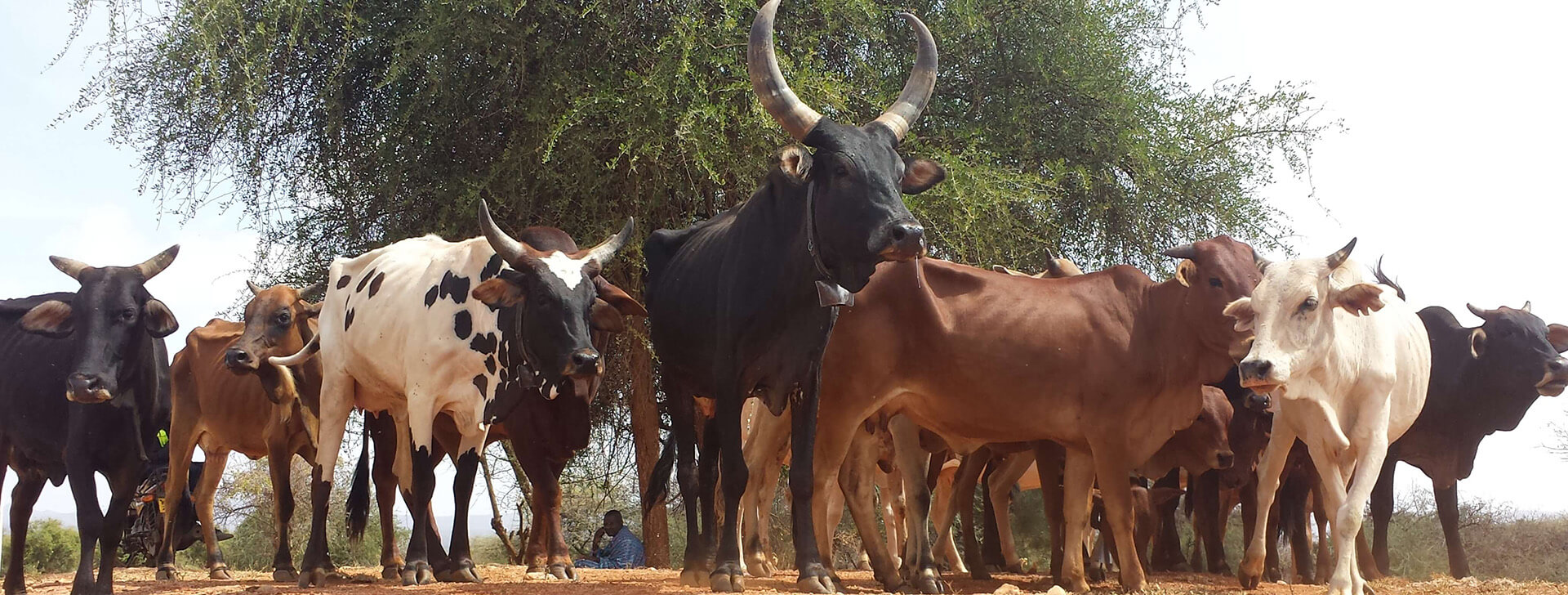
Consultancy Service: Documentation of The Kenya Pastoral Markets Development (KPMD) Initiative Business Model Compendium

Background and Rationale
The African Union Inter-African Bureau for Animal Resources (AU-IBAR), with funding from the Gates Foundation has established the African Pastoral Markets Development (APMD) Platform that is aimed at facilitating market-driven transformations in pastoralism and promoting inclusive agricultural transformation across Africa. It is implementing these market-focused interventions to enhance pastoral integration into livestock markets through multi-stakeholder fora. Preliminarily, the Platform has been translating priorities to action in two Light house countries (Kenya and Nigeria) with the potential to scale to its Strategic Outreach Countries (Benin, Burkina Faso, Cameroon, Chad, Ethiopia, Somalia, Niger, Nigeria, and Tanzania). The implementation is in collaboration with public, private and social sector partners.
Pastoral livestock systems have remained under-documented and poorly understood as a viable economic sector, with existing insights often fragmented, project-specific and not accessible to both investors and policy makers. As a result, the successes of the livestock trading initiative remain isolated with lessons largely tacit and difficult to replicate.
In Kenya for instance, the Kenya Pastoral Markets Development (KPMD) initiative, implemented with technical leadership from Strathmore Agribusiness and Food Industry Centre (SAFIC) and, has demonstrated a market systems development (MSD) approach that shifts pastoralism from subsistence-oriented production to market-driven, investment-ready value chains.
KPMD’s implementing partners (ABF United, Genco Livestock Ltd., Livemo Ltd) have piloted diverse and innovative business models across the livestock value chain, including aggregation systems, feedlot operations, contract farming, processing, digital market platforms, and livestock financing mechanisms. These models provide practical pathways for commercialization, resilience, and private sector engagement in pastoral economies.
However, these models remain fragmented and under-documented, limiting their visibility, scalability, and replication across the continent. Therefore, Africa Pastoral Markets Development Platform (APMD) under Strategic Objective 1 (SO), which focuses on enhancing continental visibility, evidence and knowledge on pastoral market systems, seeks to address this gap by systematically documenting, synthesizing, and showcasing these business models to inform policy, investment, and programming across Africa.
The APMD project, recognizes that documenting these business models not only generates structured, credible evidence on the commercially viable and inclusive approaches within pastoral systems but also helps to bridge the information gap that prevents investment and policy alignment. Further, it enables cross-country learning by translating practical experiences into adaptable frameworks, thereby accelerating replication and scaling across Africa.
To address this gap, the platform seeks to engage an individual consultant to articulate the value propositions, operational models and financial dynamics of these enterprises, to strengthen the investment case for pastoral markets by improving their perceived bankability and ability to crowd in private capital.
Objectives of the assignment
The overall objective of the consultant will be to develop a comprehensive, evidence-based case study of pastoral livestock business models that can be scaled and adapted across African markets.
Specifically to:
- Identify and document viable business models across the KPMD ecosystem.
- Analyse commercial viability, scalability and inclusivity of each models.
- Extract key lessons, success factors and enabling conditions for the enterprises.
- Develop replication guidance for different African context.
Scope of work
The consultant will undertake the following tasks:
Mapping and selection
- Identify and prioritize business models across the three KPMD implementing partners.
- Define selection criteria (viability, scalability, innovation, inclusivity)
Data collection
- Conduct key informant interviews with Strathmore Agribusiness and Food Industry Centre (SAFIC), implementing partners, private sector actors and other relevant stakeholders.
- Undertake field visits to the selected sites i.e. aggregation centres, feedlots, processing facilities etc.
- Review existing project documents, reports and datasets.
Business model documentation and analysis
- Develop detailed profiles of each business model, covering value propositions and market needs, operational structures and partnerships, revenue streams and cost dynamics, market linkages and coordination mechanisms.
- Assess each model using a standardized analytical framework, including the financial viability and investment viability, market systems integration, inclusivity and socio-economic impact, climate resilience and sustainability, and, risks and scalability potential.
Synthesis and learning
- Identify cross-cutting trends, lessons learned and success factors.
- Analyse enabling conditions and constrains affecting performance.
- Develop practical insights for replication and scaling.
Methodology and analysis
The consultant will adopt a mixed-methods, and a market systems approach to ensure a holistic and evidence-based understanding of each business model, capturing both performance metrics and the underlying drivers of success or failure.
The consultant will be expected to develop and use data collection instruments including but not limited to questionnaires, KII guides and FGD guides in relevance to the target audience.
The market systems approach will go beyond examining individual enterprises to analysing how different actors and functions interact across the value chains, including producers, aggregators, traders, processors, financiers and service providers, as well as supporting systems such as infrastructure, policies and information flows. S/he will focus on the identification of systemic constraints, incentives and relationships that influence market performance, and how business models respond to or reshape these dynamics.
The consultant will apply a robust, multi-dimensional analytical framework to systematically assess each business model, ensuring consistency, comparability and depth of analysis. The framework will integrate commercial, systemic and impact lenses.
Roles and responsibility of the individual consultant
- Develop and submit an inception report detailing the methodology, workplan and analytical framework.
- Design and apply a rigorous, standardized approach to business model documentation and analysis.
- Conduct data collection, including stakeholder interviews, field visits and document reviews.
- Engage effectively with implementing partners, private sector actors and other relevant stakeholders.
- Produce high-quality business model profiles, synthesis analysis and knowledge products.
- Ensure accuracy, consistency and confidentiality of the collected data.
- Maintain regular communication and provide progress updates throughout the assignment.
Deliverables
At the end of the assignment, the consultant is expected to deliver the following:
- Inception report detailing the methodology, workplan and proposed analytical framework of the assignment.
- KPMD business model compendium highlighting comprehensive profiles of the business models.
- Synthesis report spotlighting the lessons learned, best practises, cross-cutting insights and recommendation (both policy and practice)
- Investor brief summarizing investment opportunities
Qualification and Experience
The consultant should have and demonstrate:
- At least a degree in agribusiness, economics, development studies or related field.
- Proven experience in market systems development (MSD) and value chain analysis.
- Strong expertise in pastoral livestock systems preferably in Kenya.
- Experience in business model analysis and investment case development.
- Ability to produce high-quality analytical and knowledge products.
- Strong qualitative and quantitative research skills.
- Excellent writing and communication skills.
Key competencies
- Analytical rigor and attention to detail.
- Strong stakeholder engagement skills.
- Ability to translate complex insights into practical recommendations.
- Understanding of private sector dynamic and investment considerations
Service Duration & Location
The consultant will be expected to deliver the assignment in 21 working days. During the duration, s/he is expected to do a field visit to ABF United—Narok, Genco Livestock—Samburu, Livemo Ltd—Kajiado and Strathmore University for data collection.
Responsibilities of AU-IBAR and the consultants
i. AU-IBAR shall provide overall oversight, coordination and strategic guidance to ensure successful delivery of the assignment by:
Giving technical direction and quality assurance of the assignment, facilitate access to SAFIC and KPMD implementing partners and relevant stakeholders, share relevant background documents, data and contextual information, and, review and provide timely feedback on all the deliverables. Further, ensure the alignment of outputs with continental knowledge and learning objectives under SO1.
ii. The consultant shall
Be responsible for the end-to-end execution of the assignment ensuring high-quality, and professional delivery of all outputs. Abide by the ethical guidelines of data collection taking into consideration community engagement approaches and deliver all outputs within the agreed timelines and level of effort (LoE).
Evaluation Criteria
| Criteria | Scores (%) |
|---|---|
| Qualifications | 25 |
| General Experience | 20 |
| Methodology | 40 |
| Skills and competencies | 10 |
| Language | 5 |
| Total | 100 |
Gender mainstreaming
The AU Commission is an equal opportunity employer, qualified women are strongly encouraged to apply.
Renumeration
The individual consultant will be paid a lump Sum amount of USD 7,500 (Seven Thousand Five hundred US Dollars). The consultancy fee will be paid upon satisfactory delivery of the expected outputs.
Note that AU-IBAR will cover for any logistical costs incurred during the assignment.
Reporting and supervision
The individual consultant will work under the direct supervision of the APMD secretariat with the oversight from the AU-IBAR Director. Updates, reviews and coordination meetings will be conducted to ensure quality and timely delivery of the assignment.
Consent and intellectual property
AU-IBAR confirms that the individual consultant will own all copyright, present, future or contingent, as well as any other right, tittle or interest in the deliverables in accordance with all the copyright laws.
The consultant also agrees that AU-IBAR has the unrestricted, non-exclusive and permanent right to use the deliverables, including but not limited to, all data and literature from the assignment.
AU-IBAR has the right to use the deliverables in any way it sees fit including but not limited to, uploading them on its website, repository and is permitted to re-edit the deliverables or any portion thereof for its own exploitation.
AU-IBAR may distribute the deliverables at no cost to other stakeholders and may apply a Creative Commons Attribution (CC BY) to allow others to freely use, distribute and adapt the datasets and models as long as appropriate credit is given to the creator.
Application deadline
The address for submission of applications is: Applications including detailed curriculum vitae (CV) should be submitted through email to: procurement@au-ibar.org with a copy to Emmah.boro@au-ibar.org and should include the title: “Documentation of The Kenya Pastoral Markets Development (KPMD) Initiative Business Model Compendium” in the subject line of the email.
Applications should be submitted to the address given above by 2nd June 2026 at 23:45hrs Nairobi Local Time.
Documents forming part of this application:
- Terms of reference
- Declaration on exclusion criteria
- Data protection and privacy statement
Documents to be submitted with the application
- Methodology
- Curriculum Vitae including references of previous relevant work experience
- Identification documents e.g. passport with relevant biodata pages
- Tax status/registration documents
- Signed declaration on exclusion criteria
| Élément joint | Taille |
|---|---|
| Terms of Reference(English Version) | 1020.08 Ko |
| AU-IBAR Declaration Form | 210.95 Ko |
| AU-IBAR Personal Data Protection Form | 147.39 Ko |