

Training of ARIS advanced end users for Anglophone Countries of Eastern, Southern and selected West African Countries
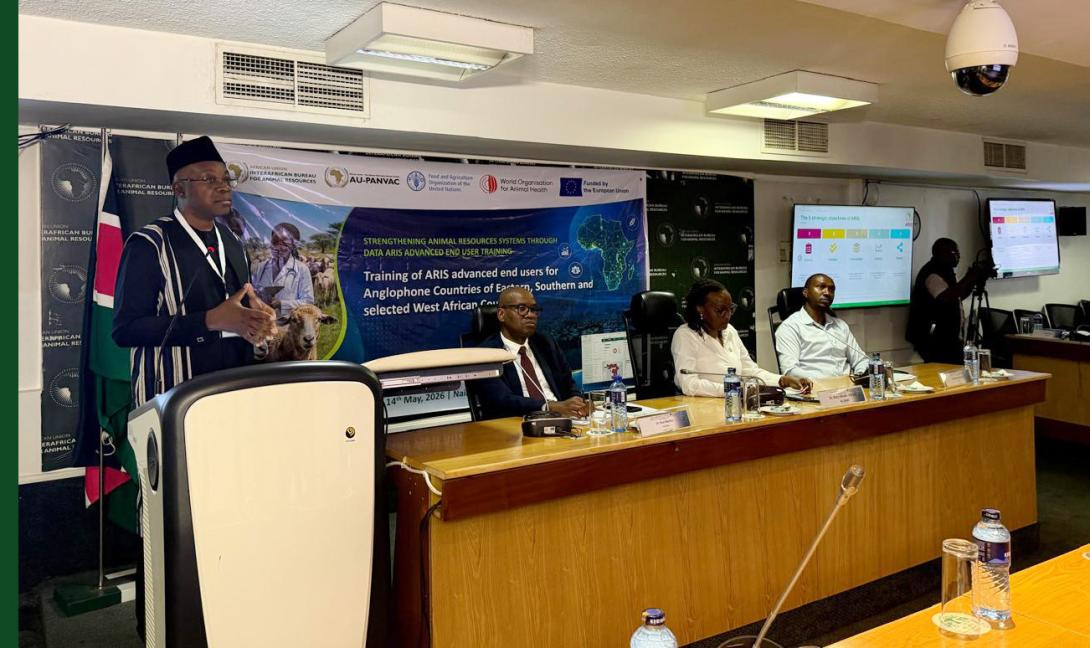
Nairobi, Kenya May 25, 2026 Effective animal health surveillance systems are one of the key pillars for the eradication of Peste des Petits Ruminants (PPR) and the control of transboundary animal diseases in Africa. With this in mind, the Pan-African Secretariat for the Eradication of PPR (PAPS), hosted by the AU-BIRA and funded by the European Union, organized an advanced training on the Animal Resources Information System (ARIS) in Nairobi.
Over four days, 66 participants from 18 English-speaking countries in East Africa, Southern Africa and selected West African countries gathered to strengthen their skills in animal health data Security management, quality assurance and quality control, surveillance of disease outbreaks, follow-up of immunization campaigns and use of data for evidence-based decision-making.

The opening ceremony was marked by strong messages from middleware partners, including the World Organization for Animal Health (WOAH), the European Union and the AU-BIRA, who reaffirmed their shared commitment to the continental goal of eradicating PPR by 2030.
Officially opening the training on behalf of the AU-IBAR Director, Dr Mary Mbole-Kariuki emphasized the central role of data quality in the effectiveness of health policies and interventions.
« Data quality is not a secondary technical issue. It is at the very heart of the effectiveness of our policies and interventions, » she said. She also encouraged participants to become national resource persons, data quality custodians and change makers capable of strengthening surveillance systems at the national and local levels.

Representing WOAH, Dr Néo Mapitse highlighted the critical magnitude of interoperability between national and regional systems such as ARIS and global reporting platforms such as WAHIS. In his view, better data integration is essential to strengthen disease reporting and effectively coordinate health responses.
On behalf of the European Union Delegation to Kenya, Mr Kagure Charles Muteithia recalled that reliable data on animal populations are essential for planning vaccination campaigns, estimating vaccine needs, supporting research and guiding public policies. He emphasized that « without data, it becomes very difficult to develop effective policies or implement Suitable information disease control and detection measures. » He stressed that reliable information on livestock numbers is the basis for effective planning of vaccination strategies and better preparedness for health threats.
During the training, participants deepened their knowledge on the strategic use of ARIS for animal disease surveillance, improving data quality, monitoring vaccination campaigns and assessing progress towards the eradication of PPR and other priority animal diseases.
The training also provided a privileged space for peer-to-peer exchange and learning. Participants actively shared national experiences, discussed challenges in data collection and security management, and asked many technical and operational questions related to the use of ARIS. These discussions provided concrete solutions, clarified several aspects of the system and strengthened the common understanding of good practices in animal health surveillance.
Beyond technical capacity building, the workshop fostered increased collaboration between Member States, Regional Economic Communities and technical partners around a common goal: reliable information systems that can support informed decision-making and accelerate the fight against transboundary animal diseases in Africa.

After four days of work, participants left Nairobi with enhanced skills to generate, validate, analyse and effectively use animal health data to rapidly identify disease outbreaks, track vaccine shortfalls, measure progress and sustain coordinated actions at the regional level.
At the closing of the workshop, AU-IBAR Director Dr Huyam Salih reiterated the commitment of the organization to support Member States, Regional Economic Communities and partners to ensure that improved data systems are translated into enhanced surveillance, better preparedness for health threats and accelerated efforts to eradicate animal diseases on the continent.
This training illustrates the ongoing commitment of PAPS, AU-IBAR, WOAH, the European Union and Member States to build modern, robust and interconnected surveillance systems, which are essential to achieving the PPR2030 goal and to the sustainable protection of the livelihoods of millions of African livestock farmers.