

Investors, Innovators and Policymakers Chart a Path to Industrialise Africa's Feed and Fodder Sector
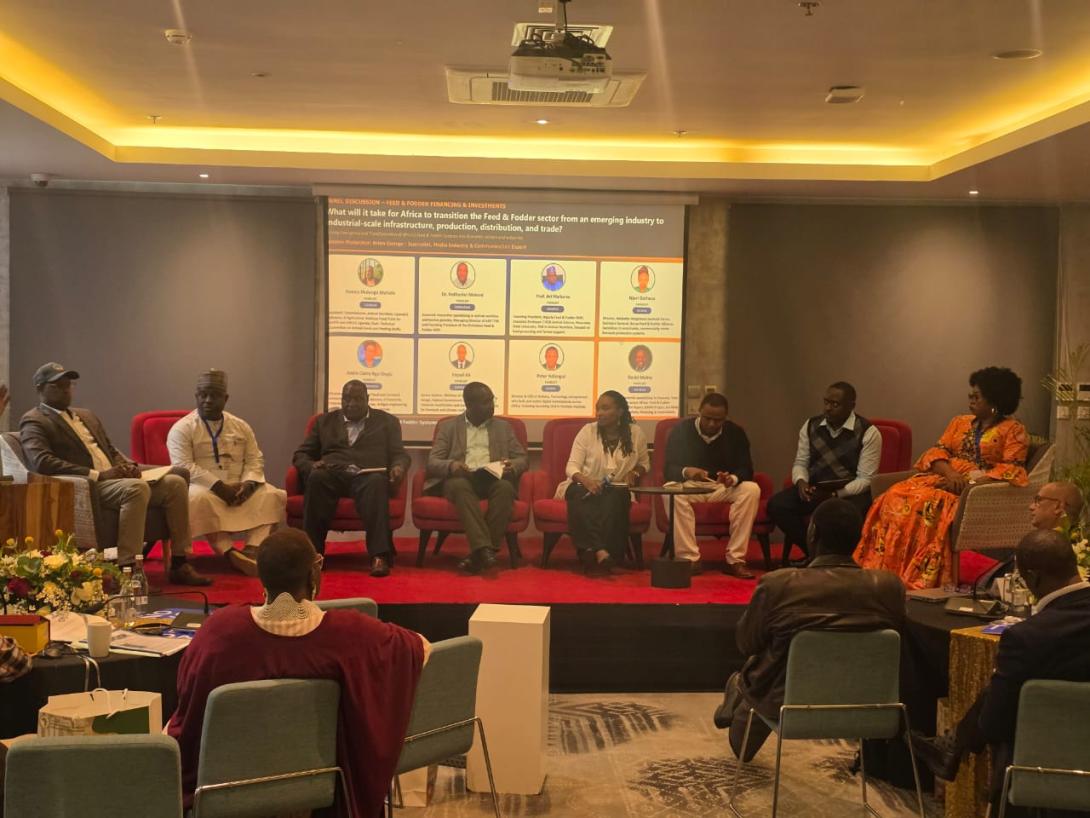
Nairobi, 30 June 2026: A high-level panel discussion on financing and investment brought together government officials, researchers, entrepreneurs and private sector leaders from six African countries to confront a single, pressing question: what will it take to transition Africa's feed and fodder sector from an emerging industry into industrial-scale infrastructure, production, distribution and trade?
The session, held as part of the closeout of the Resilient African Feed and Fodder Systems (RAFFS) Project, was moderated by journalist and communications expert Brian George and convened panellists from Kenya, Uganda, Nigeria, Zimbabwe, Cameroon and Somalia alongside AU-IBAR's own technical experts. Framed under the broader theme of "Driving Emergence and Transformation of Africa's Feed and Fodder Systems into Economic Sectors and Industries," the discussion moved country by country, surfacing a strikingly consistent set of bottlenecks and a shared appetite for solutions.
Kenya: Reframing Fodder as a Commercial Commodity
Speaking on behalf of the Kenya Feed and Fodder Alliance, Njeri Gatheca opened by reframing what is often seen as a production problem. With national feed demand at roughly 16 million metric tonnes a year and a supply gap of around 40 per cent, the temptation is to treat this purely as a shortage of output. Instead, the panellist argued that the more fundamental issue is one of market organisation and investment architecture, the absence of the institutional and commercial scaffolding needed to attract capital at scale.
Three shifts were identified as central to Kenya's strategy: repositioning fodder from a subsistence, drought-response activity into a commercially viable commodity in its own right; actively convening the market, exemplified by the country's first feed and fodder contracting and investment forum held the previous year, which brought together producers, transporters, traders and financiers; and pursuing targeted financing instruments, including what was referred to as the SAFE Fund, designed to address the specific risk profile of the feed and fodder value chain rather than relying on generic agricultural financing models. The panellist also pointed to simple regulatory friction, such as inconsistent cess charges on fodder transport across counties, as a tangible barrier to ease of doing business that could be resolved relatively quickly.
Uganda: Untapped Potential and the Logistics Gap
Uganda's representative, Dennis Mulongo Maholo, described a country positioned as a $3.5 billion feed and fodder hub, with 80 per cent arable land, river-basin irrigation potential, and the backing of the 2023 Animal Feed Act. Yet an estimated 52 million tonnes of biomass is lost annually due to inadequate processing and logistics infrastructure.
The panellist pointed to underinvestment in infrastructure and services as the core constraint, alongside the often-overlooked role of the "middleman" in market systems. Rather than viewed as a problem to be eliminated, intermediaries were described as essential connective tissue between producers and markets, and their exclusion from formal systems was identified as a source of market instability. Uganda's response includes developing a resilience and agility framework to support consistency of quality for regional markets (Kenya, Rwanda, South Sudan) and increasingly for markets in Europe, the US and China, alongside efforts to build partnerships and shared data systems that allow grain manufacturers, fodder producers and financiers to "speak the same language."
Nigeria: From Import Dependency to Export Ambition
Despite being Africa's largest economy, Nigeria remains heavily dependent on feed and concentrate imports. The Nigeria Feed and Fodder Multi-Stakeholder Platform (MSP) representative outlined a strategy anchored in political will, including the creation of a dedicated ministry focused on livestock sector growth, and the aggregation of private sector players, financiers and supporters under a unified national framework.
Notable initiatives include exploring the listing of feed and related commodities on Nigeria's commodity markets, shifting focus from domestic consumption standards toward export-grade standards that can cascade down to state and local levels, and addressing the regulatory fragmentation that has historically left a large share of industry players — citing the poultry sector as an example — operating outside formal oversight. The panellist also highlighted work on fodder crop standards as a critical, underdeveloped opportunity for investors.
Zimbabwe: Building on Agricultural Strength
Zimbabwe's panellist, Dr. Nathaniel Makoni, drawing on a background in livestock research and multi-stakeholder platform leadership, framed the role of the MSP as building the inter-firm relationships needed to capture and grow agro-industrial opportunity. The country's advantage lies in a strong base of skilled commercial farmers alongside smallholders, supported by relatively well-organised producer associations such as the Zimbabwe Association of Dairy Farmers and institutions like the Livestock Market Advisory Council and Agricultural Marketing Authority for Grain, which provide real-time market data to inform decision-making.
Key priorities identified included expanding irrigation and water storage infrastructure given Zimbabwe's single rain season, investing in densification and compression equipment to manage the logistics of bulky feed products, and developing standards that emerge organically from the industry rather than being imported wholesale, to avoid excluding new entrants. Looking specifically at the next 24 months, the panellist pointed to hay production as a near-term opportunity, both to meet domestic demand and to serve regional markets in Zambia, Botswana, Mozambique, Malawi and South Africa, all of which face feed and fodder deficits. Offtake agreements between millers and farmers were cited as an emerging and valuable planning mechanism, particularly with El Niño-related supply disruptions on the horizon.
Cameroon: Land Endowment Awaiting Activation
Cameroon's representative, Mrs. Annie Claire Ngo Ongla, addressed the scale of opportunity and loss in the country's Adamawa region, where animal feeding deficits are estimated to cost over 350 billion CFA francs annually, despite less than 30 percent of 7.2 million hectares of arable land currently under cultivation. The government has earmarked over 400,000 hectares for agricultural development, and the newly established PCASA Multi-Stakeholder Platform was highlighted as a vehicle for converting this land endowment into industrial-scale feed production and attracting coordinated investment.
Somalia: Innovation, Climate Risk and Market Access
Feysal Ali, representing Somalia, brought a distinctive lens to the discussion, framing today's investment climate as fundamentally shaped by climate change in a way that simply was not true a generation ago. With feed production now classified as high-risk by financiers, given its exposure to drought and water scarcity, the panellist argued that the sector needs to think beyond traditional, capital-intensive production models and instead pursue innovation that delivers convenience, affordability and efficiency, drawing a comparison to the rapid growth of the pet food industry as a model for accessible, scalable feed products.
Despite importing an estimated 70 percent of its animal feed, Somalia maintains a thriving live animal export trade, with premium-quality livestock reaching Gulf markets. The panellist pointed to regional interconnection, both physical logistics and the ease of cross-border movement, as a major unlock, contrasting the relative ease of travel within parts of the Gulf region with the visa barriers that complicate movement even between neighbouring African states such as Kenya, Uganda and Tanzania. A specific data gap was also raised: livestock statistics in some countries exclude categories such as donkeys and pigs, a methodological inconsistency that may be distorting the true picture of feed deficits across the continent, a question directed to AU-IBAR for further consideration.
Bankable Opportunities: A Technology Entrepreneur's View
Bringing a private investment and technology lens to the discussion, the panel identified three concrete, near-term bankable opportunities: logistics and storage infrastructure, cited repeatedly across country presentations as a binding constraint; production of high-yield, lower-cost fodder crops; and waste valorisation, particularly the collection, packaging and pelleting of agricultural byproducts into sellable, export-ready feed products.
AU-IBAR's Closing Reflection: A Call for a Continental Financing Mechanism
Closing the session, AU-IBAR's Development Economist and Feed and Fodder Business Development Expert for the RAFFS Project, David Maina, synthesised the country interventions into a common thread: each nation's challenges, while locally specific, point toward the same underlying gap, the absence of a coordinated mechanism to capitalise and de-risk investment across the sector.
He noted that while capital exists in the broader financing landscape, it has not flowed to feed and fodder at the scale required, partly because the sector remains rated as high-risk and partly because no one has systematically demonstrated the unit economics of investment in African feed and fodder value chains. Without that evidence base, he argued, financiers will continue to ask for proof of return that the sector currently cannot supply.
In a direct appeal to the room, he proposed that the panel adopt a formal resolution calling for the establishment of a consistent, well-capitalised continental financing mechanism for feed and fodder, anchored at AU-IBAR, to systematically build and communicate the unit economics of investment across the value chain, turning the recurring, fragmented requests for support into a coordinated, bankable continental case for investment.
Looking Ahead
The discussion underscored that while the specific constraints vary by country (logistics in Uganda, market architecture in Kenya, regulatory fragmentation in Nigeria, infrastructure in Zimbabwe and Cameroon, climate risk and connectivity in Somalia), the underlying challenge is shared: mobilising patient, sector-specific capital into a value chain that has historically been treated as an emergency response rather than a commercial opportunity.
As the RAFFS Project draws to a close, the panel's call for a continental financing mechanism offers a concrete marker for what comes next: moving from country-level pilots and platforms toward a coordinated continental architecture capable of attracting the industrial-scale investment Africa's feed and fodder sector needs.