
Fodder Means Business: AU-IBAR Takes Its Livestock Evidence Drive to the Isiolo Fodder Expo
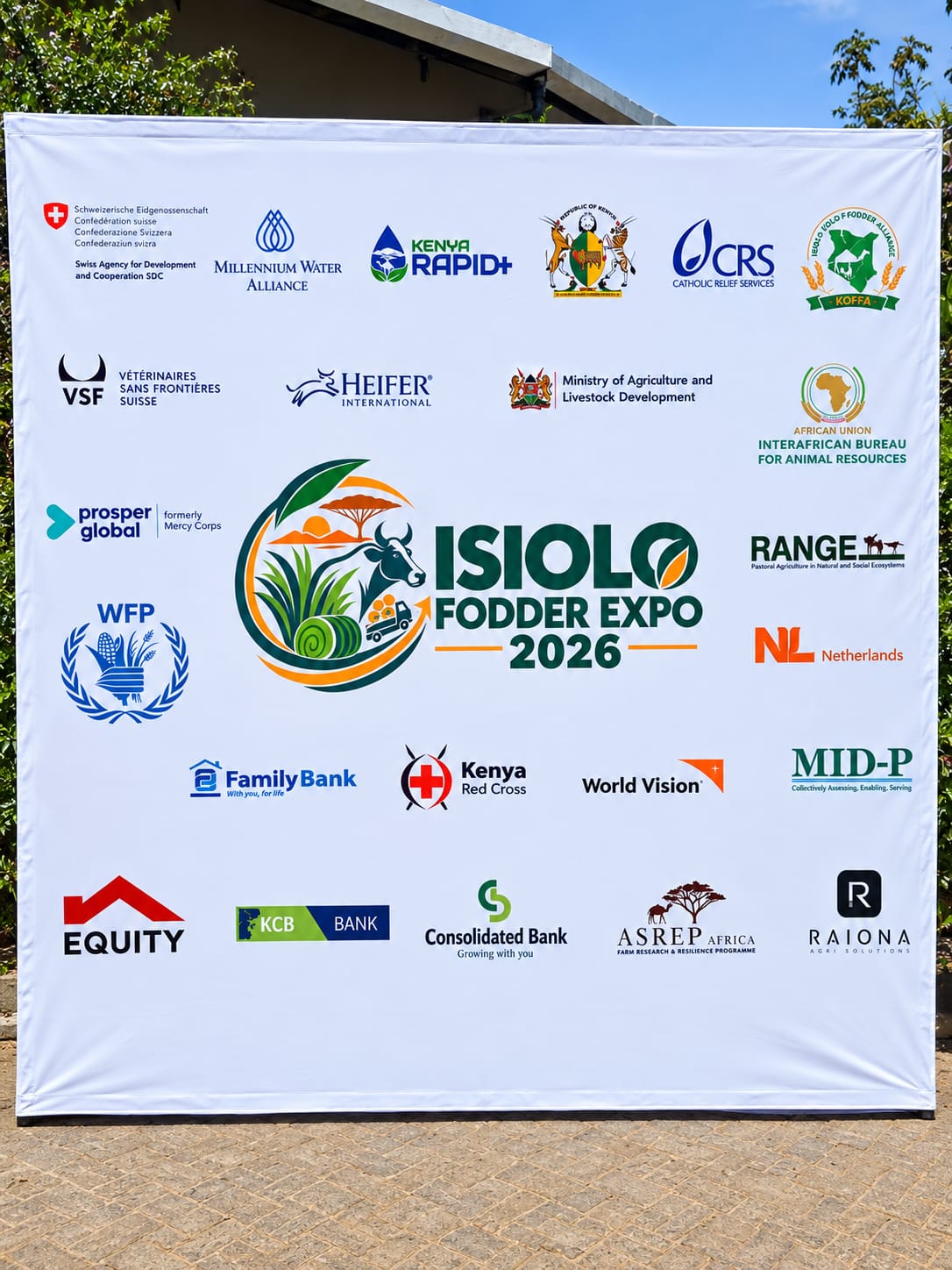
The Kenya Feed and Fodder Alliance (KeFFA) brought together fodder producers, traders, livestock keepers, banks, county officials, and development partners at the Isiolo Fodder Expo & Market Linkage Fair 2026. The theme was "Catalyzing Commercial Fodder Markets for Climate Resilience and Strengthening Livestock Productivity in Northern Kenya." The message was simple: in Kenya's arid and semi-arid lands, fodder should no longer be an emergency handout during drought. It should be a year-round business.
KeFFA's county-to-county approach, which puts the arid and semi-arid lands (ASALs) first, fits closely with the continental feed and fodder agenda. The expo covered the full journey from field to animal: fodder production, harvesting, aggregation, market linkages, livestock productivity and climate resilience. The range of partners showed how far the alliance has come. Banks such as Equity Bank and Family Bank sat alongside humanitarian and development organizations including the World Food Programme, the Kenya Red Cross, World Vision and Heifer International, together with national and county government.
The African Union InterAfrican Bureau for Animal Resources (AU-IBAR) joined the expo as a partner and used it to open the Isiolo leg of its field data collection. The data will feed two assessments that AU-IBAR is carrying out for the United Nations Economic Commission for Africa (UNECA) under the project "Accelerating Food Systems Transformation for Resilience to Climate Change in Africa." The first strand of the assessment is focused on the livestock value-chain; on the red meat value chain (cattle, sheep and goats) from Garissa and Isiolo to Nairobi and export markets. The other follows camel milk from Marsabit, Mandera and Wajir through Isiolo to Nairobi and Mombasa. The second strand assesses how well livestock insurance is working for pastoralists. Fieldwork runs from 28 September to 15 October 2026 across Isiolo, Garissa and Nairobi, with other counties reached by telephone.
Isiolo was a natural choice. It is the hub for both value chains, with an export abattoir, a major livestock market, women-led camel milk cooperatives and the main road link to Nairobi. The assessment aims to inform on the costs and profits at each stage of the chain, where milk is lost, what credit is available to producers and traders, and why some pastoralists keep their insurance cover while others let it lapse.
At the centre of it all is feed. At the Kenya National Inception Meeting in July, three separate expert groups reached the same conclusion: feed and fodder are the biggest constraint on Kenya's pastoral livestock economy. Participants estimated that the country faces a feed deficit of about 60 percent even in good rainfall years. They also noted that insurance payouts cannot protect animals if there is no fodder to buy. Their verdict was that fodder must grow into a sector in its own right.
This builds on strong momentum. The Kampala CAADP Declaration commits African countries to invest in better fodder and alternative feed sources. In Kenya, KeFFA has already hosted the country's first fodder investment forum, with support from AU-IBAR's Resilient African Feed and Fodder Systems (RAFFS) project. That forum introduced new financing models for dairy cooperatives and pastoral counties, and Kenya's investment profile values the national fodder opportunity at USD 4.5 billion.
The findings from Isiolo and the other counties will be validated with national and county stakeholders and turned into practical, costed recommendations for reform and investment. The goal is a livestock economy that plans for drought rather than reacting to it. AU-IBAR thanks KeFFA, the County Government of Isiolo and all participants for making the expo a platform for both business and evidence.