Act Together for One Health: AU-IBAR advances prevention, data integration and preparedness across Africa
Nairobi, 3 November 2026
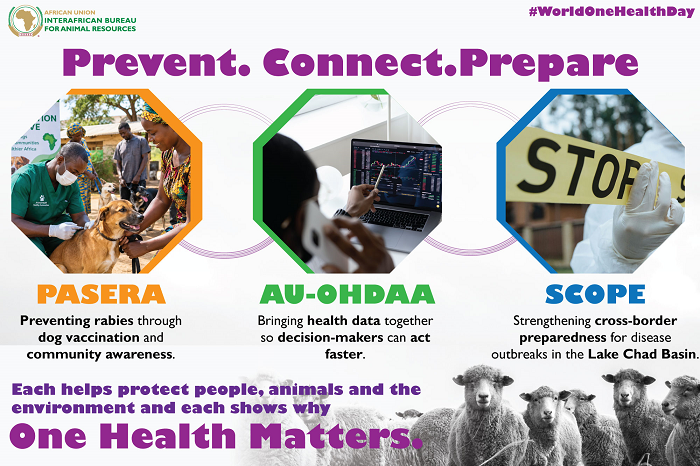
Picture three scenes. A veterinary team vaccinating dogs at a community post. A data officer trying to match an animal disease report with a human case record held in another ministry. Health officers on either side of a border in the Lake Chad Basin, working out who should act on an unusual cluster of illness.
Each scene sits in a different place and a different sector. Yet they share one lesson: disease does not stay in the lane we assign to it. It moves between animals and people, through shared environments and across borders. Our response has to move the same way.
That is the thinking behind World One Health Day, marked every year on 3 November. This year’s theme, “Act Together for One Health”, calls for stronger collaboration across sectors and more coordinated action to prevent, detect and respond to health threats.
For Africa, the call is practical, not abstract. Zoonotic and transboundary animal diseases continue to threaten lives, livelihoods and food systems. Many of these threats begin in animals, which places animal health systems on the front line of public health protection.
This World One Health Day, the African Union Inter-African Bureau for Animal Resources (AU-IBAR) is highlighting three continental initiatives that show what acting together looks like in practice.
Stopping rabies where it starts
Rabies is almost always fatal once symptoms appear, yet it is entirely preventable. In Africa, domestic dogs cause most human infections. Treating people after a bite saves lives, but it does not end the disease. Vaccinating dogs does.
Through the Pan-African Strategy to Eliminate Rabies in Africa (PASERA), AU-IBAR provides a continental framework that brings veterinary and public health services, communities and partners onto the same page. The strategy supports coordinated surveillance, dog vaccination, public awareness and appropriate care for people who have been exposed.
The principle is simple: protect the dog, and you protect the family.
Making data work across sectors
One Health runs on information. When animal, human and environmental health data sit in separate systems that cannot talk to each other, warning signs are missed and decisions take longer than they should.
The African Union One Health Data Alliance Africa Project (AU-OHDAA) is tackling this problem at its roots. Building on AU-IBAR’s earlier One Health work and aligned with continental policy frameworks, the project is supporting:
-
a continental One Health information policy;
-
an information architecture and maintenance model;
-
stronger technical and infrastructural capacities; and
-
a continental digital One Health platform.
The goal is a connected data landscape, where a warning seen in one sector can be acted on in another.
Preparing beyond borders
Health threats do not stop at a checkpoint. In the Lake Chad Basin, where people, livestock and trade move across national boundaries every day, preparedness has to be regional to be effective.
The Strengthening One Health Capacities for Pandemic Preparedness in the Lake Chad Basin (SCOPE) Project aims to strengthen cross-border One Health capacities in the region by 2029. It focuses on three areas:
-
Prevention, detection and response: building capacities to prevent, detect, notify and respond to pandemic threats across borders.
-
Governance and coordination: strengthening cross-border mechanisms that support inclusive and equitable One Health systems.
-
Financing and partnerships: fostering innovative, sustainable funding and strategic partnerships for pandemic prevention, preparedness and response.
The message is clear: health threats do not respect borders, and neither should preparedness.
One approach, three levels of action
The three initiatives show that One Health is not a single intervention. It works at several levels at once.
|
Contribution |
Initiative |
What it shows |
|---|---|---|
|
Disease prevention and control |
PASERA |
Protecting people by tackling disease at its animal source |
|
Digital integration and information sharing |
AU-OHDAA |
Connecting data and systems for better governance and decisions |
|
Preparedness and response |
SCOPE |
Building cross-border capacity, governance and partnerships |
PASERA prevents disease at source. AU-OHDAA connects the information that drives decisions. SCOPE builds the shared capacity to respond when threats emerge. Each strengthens the others.
Acting together
As it commemorates World One Health Day 2026, AU-IBAR reaffirms its commitment to collaboration, integrated systems and collective action. By strengthening animal health systems, promoting digital One Health governance and supporting cross-border preparedness, AU-IBAR continues to contribute to a healthier, safer and more resilient Africa.
The invitation to Member States, Regional Economic Communities, partners and communities is the same as this year’s theme: act together.