

From herds to industries: Livestock Value Chain Assessments led by AU-IBAR finds Somalia’s livestock sector ready for transformation
Somalia’s livestock sector is starting to move from herds to industries, but producers still carry most of the costs and risks while the benefits sit further down the value chain. These are among the preliminary findings of a field assessment conducted by AU-IBAR for the United Nations Economic Commission for Africa (UNECA), in collaboration with Somalia’s Ministry of Livestock, Forestry and Range.
Mogadishu, 12 November 2026 – The African Union Interafrican Bureau for Animal Resources (AU-IBAR) presented the preliminary findings of its assessment of Somalia’s livestock value chains and livestock insurance (takaful)) to the Office of the Minister and the Director General of the Federal Ministry of Livestock, Forestry and Range (MoLFR). The Ministry described the findings as “the right direction” and asked the team to move ahead with analysis and drafting of the full report.
The Somalia mission is one of three field assessments AU-IBAR has carried out under the UNECA assignment, alongside Kenya and Uganda. The assessments examine how livestock value chains work in each country, where value is lost, and how livestock insurance, known in Somalia as takaful, can better protect pastoralists against drought and other shocks.
The whole value chain in one room
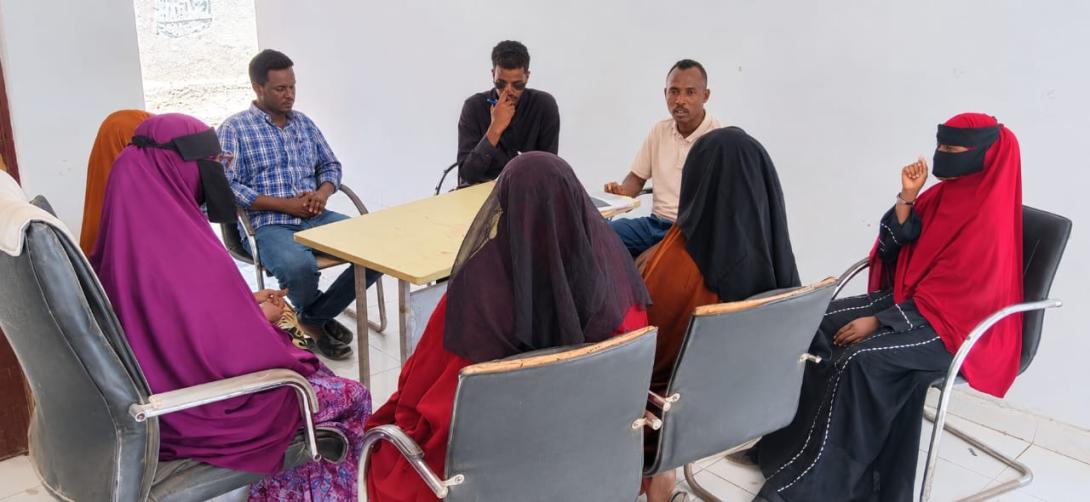
Between 9 and 12 November 2026, the AU-IBAR team, held nine stakeholder panels in Mogadishu. More than 50 key informants took part, using tools tailored to each group. The team also visited an export quarantine facility, a bank and livestock markets, and held a focus group discussion with women milk traders.
Participants represented the whole value chain: MoLFR departments, the Somali Bureau of Statistics, the Ministry of Commerce and Industry and the Somali Disaster Management Agency; traders’ associations, peri-urban dairies and cooperatives; silage, concentrate and poultry-feed producers; veterinary associations, including the Veterinary Women Association; meat processors and hides-and-skins traders; Salaam Somali Bank, Baraka Takaful and the DRIVE programme; and universities, research firms, FAO and other partners. State teams are collecting data in parallel in Puntland, South West State and Jubaland, bringing the expected number of participants to about 150.
Peace dividends are turning herds into industries
The assessment found that improved security is allowing new livestock industries to take shape, beginning downstream. This is in step with Somalia’s National Transformation Plan, which shifts the focus from development to transformation and value addition.
Somalia already has modern, ISO and Halal-certified meat plants exporting to Oman and the United Arab Emirates, with markets in Qatar and Bahrain opening. A commercial feed and fodder industry has emerged in just three to four years. Peri-urban camel and cattle dairies are growing to meet strong demand for milk, and financial services now reach herders directly: pastoralists open bank accounts on basic feature phones, and stakeholders reported that about 150,000 accounts opened under the DRIVE programme have increased takaful sign-up.
Production at the herd level, however, remains largely traditional, and insecurity still limits access to some source areas.
From cattle to camels, with ecological costs
Repeated droughts have pushed many cattle out of central Somalia towards Jubaland and north-eastern Kenya. Camels, sheep and goats, which browse and survive drought better, now dominate, and camel dairying is spreading. Stakeholders stressed that this was not a choice: Somali herders traditionally preferred cattle.
The shift has costs. Browsing and charcoal production are stripping tree cover, invasive Acacia and Prosopis species are spreading, and exposed soils no longer absorb rainfall. Heavy off-take, weak herd replacement and limited breed improvement are also changing herd structure. Somalia’s last livestock census dates from 1980, so current herd sizes are estimates. The team recommends an in-depth study of what is driving the shift and its impact on rangelands.
Drought and floods in the same rivers
Somalia now faces both extremes. With tree cover gone, rain runs off instead of soaking in, carrying topsoil into the rivers. The Shabelle River, once three to four metres deep, has not been maintained for decades and is silting up. All-season surface water is shrinking and salty groundwater is taking its place, while floods have become routine in Hiiraan and Middle and Lower Shabelle when large volumes of water arrive from upstream at once.
Stakeholders called for Somalia to be ready to receive and use this water by building storage, desilting rivers and maintaining waterways, alongside dialogue on the timing of upstream releases.
A nation of milk drinkers that imports its milk
Somalia imports an estimated USD 200 million worth of milk and milk powder each year, despite having one of the largest livestock populations in the region. Indigenous cows produce only five to six litres a day, and the country’s estimated five million cattle have no structured breeding programme behind them.
Poor genetics, a stalled artificial insemination service, high cooling costs from diesel-powered electricity and the absence of a dairy board or milk authority all hold the sector back. Progress is under way: a breeding centre in Mogadishu under the Food Systems Resilience Programme (FSRP) has gone to tender, and the African Development Bank is supporting genetics and fodder in three riverine states. Stakeholders agreed that Somalia has enough milk consumers to build the biggest dairy industry in the region.
Export value, not just animals
The assessment identified two distinct market tracks, each needing its own policy. Terminal slaughter markets, including Mogadishu itself, trade lower-grade animals, culls and females, with goats selling for about USD 80–120. At one market visited, about 800 local goats are traded and 80–100 slaughtered each day. In drought, these markets swell with distress sales and prices fall.
Export markets take only top-grade males, at about USD 120–150 a goat, keeping breeding herds at home. Most live exports leave through the northern ports of Berbera and Bosaso, while Mogadishu ships by small vessels to Oman and the UAE between October and May. Demand peaks during Hajj.
The team proposes that Somalia position Hajj as its premium live-animal market while routine exports move towards chilled meat. Exporters buy carcasses at about USD 3.5–4.5 per kilogram, while meat sells for about USD 8 per kilogram in Oman, value that could stay in Somalia with the right investment in processing and air freight.
Markets without vets, inspectors or animal identification
At a Mogadishu livestock market, the team found no veterinarian, meat inspector or quarantine officer on site. Animals carried no ear tags or marks, and their origin, route and vaccination status were unknown. A suspected case of foot-and-mouth disease was being treated by its owner. Standards are currently driven from the port backwards, as exporters enforce importers’ requirements so that animals pass inspection, but producers upstream receive little support.
Market charges are light, at about USD 1 to enter and no movement permit, but the tax burden falls instead on imported inputs. The team warned that a single untraced disease outbreak could trigger an export ban, and identified the DRIVE programme’s livestock traceability system as an entry point for animal identification.
Value leaks at every step from rangeland to port
Stakeholders reported that value is lost at every stage of the chain. Feed is the first gap: the country faces a feed deficit of about 35%, about 40% of available feed resources are wasted, and silage meets less than 10% of demand. Safe handling of milk and meat is largely absent, and electricity generated from diesel is among the costliest anywhere, making cooling and processing expensive.
Moving animals to market is also costly. Herds trek for up to 18 hours along unprotected corridors, while irrigation is taking over the riverine land that once provided dry-season grazing. In processing, five tanneries have closed. Although a hide accounts for 15–18% of a cow’s value, skins now sell for between USD 0.25 and USD 4. Import duties on feed inputs and day-old chicks add to the burden and hold back domestic industry.
The result is an extractive chain in which producers carry the costs and risks, while benefits and investment are concentrated downstream.
A strong private sector without a sector framework
Somalia’s private sector is robust but fragmented, often organised around family and clan interests rather than the development of the sector as a whole. There is no dairy, meat or export board and no milk authority, and key sector strategies remain in draft. Private veterinary bodies fill the gap left by public services and need backing through a veterinary board, common standards and a single testing protocol across the country’s nine quarantine stations. Skills also lag behind the sector’s growth, with no breeding policy or certification and no university degree in animal industries.
Stakeholders pointed to the telecommunications sector, which grew even during the conflict, as proof that Somali enterprise can build industries in which many people hold a stake.
Takaful that builds on clan and Islamic solidarity
The assessment found strong demand for Sharia-compliant livestock insurance. Herders who have received payouts are now willing to pay premiums of up to USD 60, compared with about USD 11 before. Demand far exceeds supply: in some areas 15,000–20,000 herders want cover, but only 1,000–2,000 places are available, about ten times the current quota.
Somalia’s traditional clan-based safety net, in which families pool resources (diya) to restock households after a loss, helps explain why uptake has been stronger than in Kenya. Six months of engagement with religious scholars and mosques helped resolve early questions about whether insurance is permissible. Stakeholders recommended that takaful complement rather than compete with clan solidarity: sell through sub-clans and groups, design products for women outside clan cover, verify losses by herd location rather than registered district so that mobile herders are protected, bundle animal health services, and extend cover to floods.
Six moves to turn peace into a livestock economy
The team proposed six priority actions for the Ministry’s consideration. The first is a sector framework, with dairy, meat and export boards, a milk authority and apex bodies that bring clan-based businesses together. The second is to protect the production base by securing livestock corridors and riverine grazing, desilting rivers and storing upstream water releases. The third is to build the feed industry by finalising the feed and fodder policy, planning for camel dairy, removing taxes on feed inputs and developing fodder seed.
The fourth action is to export value rather than only animals, keeping Hajj as the premium live-animal market, exporting chilled meat by air for the rest of the year and reviving the hides and skins industry. The fifth is to back the private sector’s self-regulation through a veterinary board and standards, vets and inspectors at markets, a single testing protocol and animal identification. The sixth is to invest in skills and evidence, including the breeding centre and artificial insemination, animal-industries degrees, a national livestock census and the scaling up of takaful through clan structures.
Within five to ten years, these steps could give Somalia a thriving dairy industry, quality leather, year-round meat exports with live animals for Hajj, and protected rangelands.
Ministry guidance and next steps
At the briefing, the Director General’s Office confirmed that the findings match the Ministry’s own view. It asked the team to harmonise data from the federal member states, frame the report around the National Transformation Plan, make the case for a next phase of the DRIVE programme, and explore climate finance opportunities, including loss and damage funding. The Ministry also requested a separate assessment of meat exports and trade data.
The team will now analyse the data from Mogadishu and the states and prepare a draft report for the Ministry’s review in December, followed by a revised draft to UNECA. A validation workshop with stakeholders is planned for early 2027. Finalising Somalia’s feed and fodder policy has been identified as an early quick win.
About the assessment
AU-IBAR is conducting livestock value chain and index-based livestock insurance assessments in Kenya, Uganda and Somalia on behalf of the United Nations Economic Commission for Africa (UNECA). In Somalia, the assessment is carried out in collaboration with the Federal Ministry of Livestock, Forestry and Range. Figures in this article were reported by stakeholders during the assessment and are preliminary, pending verification in the final report.