
Catalyzing Transformation towards Sustainable Livestock Systems (LiveSys)
Background
- Livestock is critical to livelihoods in Sub-Saharan Africa, supporting 80 percent of poor households in Eastern and Southern Africa and contributing around 40 percent of agricultural GDP.
- Two-thirds of livestock farmers are women, mostly raising small livestock species.
- Demand for animal products is expected to double by 2050, driven by population growth, rising incomes and urbanisation.
- Climate change is reducing animal productivity, forage growth and feed availability, while fuelling conflict over land and water.
- Livestock also contributes around 15 percent of global greenhouse gas emissions and 60–80 percent of agricultural deforestation, though Africa's share remains small.
- Agricultural and food systems received only 7.2 percent of global climate finance in 2021/22, with little reaching livestock.
- Sustainable pathways remain open, but weak policy prioritisation and investment overlook livestock's potential for livelihoods, climate action, biodiversity and land restoration.


Latest Resources

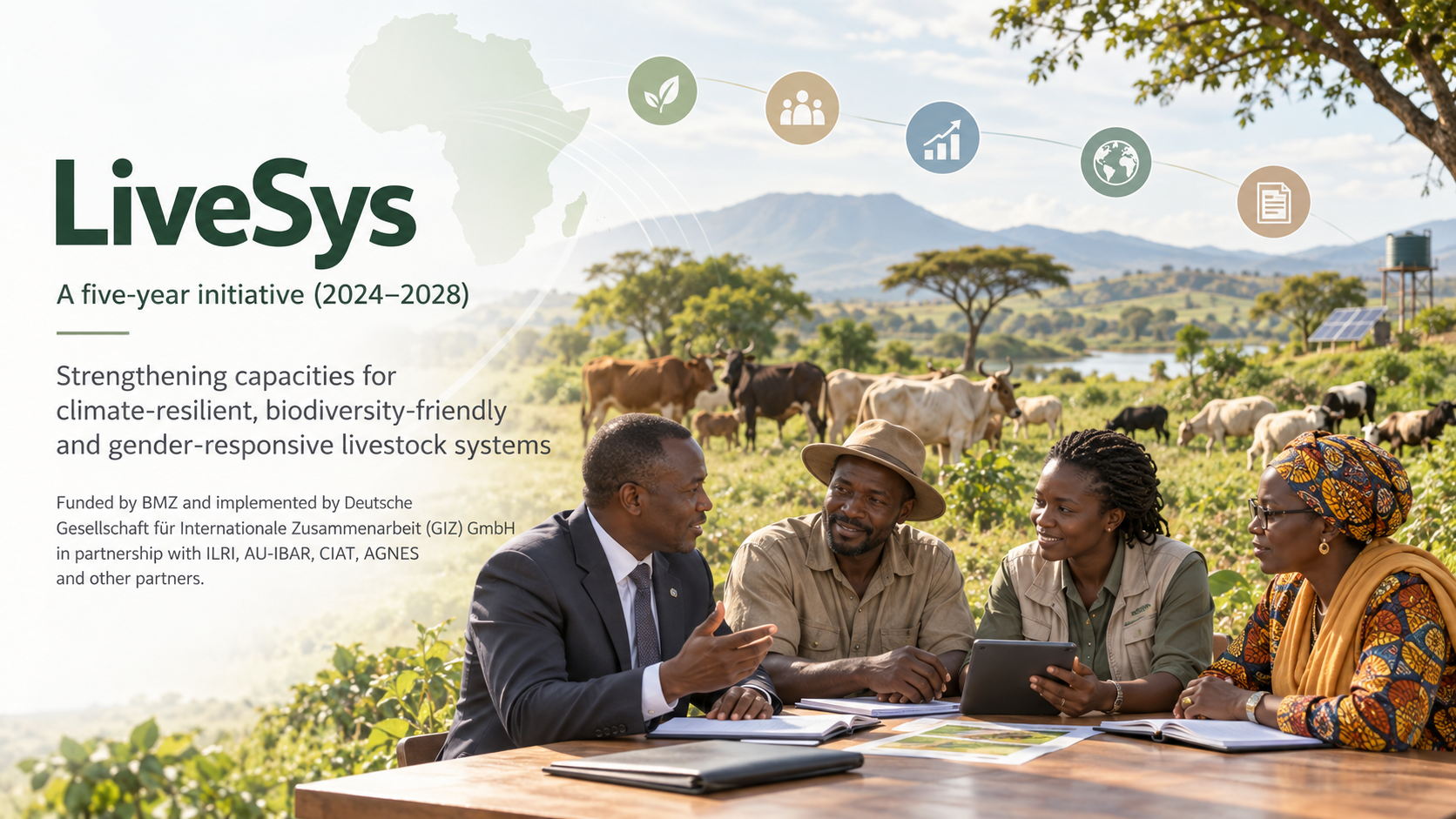
LiveSys is a five-year initiative (2024–2028) funded by BMZ and implemented by Deutsche Gesellschaft für Internationale Zusammenarbeit (GIZ) GmbH in partnership with ILRI, AU-IBAR, CIAT, AGNES and other partners.
It is designed to strengthen the capacity of key actors, including government officials from African Union member states, regional economic communities, livestock producer organisations, and national focal points for the Rio Conventions, to develop policies and financing mechanisms for climate-resilient, biodiversity-friendly, and gender-responsive livestock systems.
This initiative reflects a broader understanding that transforming livestock systems requires more than technology. Lasting change requires capable institutions, informed policies, and professionals who can navigate climate science, agricultural practice, finance mechanisms, and social inclusion.
Project Goal
Our goal: The global project “Catalysing transformation towards sustainable livestock systems (LiveSys)” supports global, regional and national decision-makers in capacity, policy and financing instruments to help protect the climate, biodiversity and land through sustainable livestock systems.

xxxxx
What is the future of pastoralism?
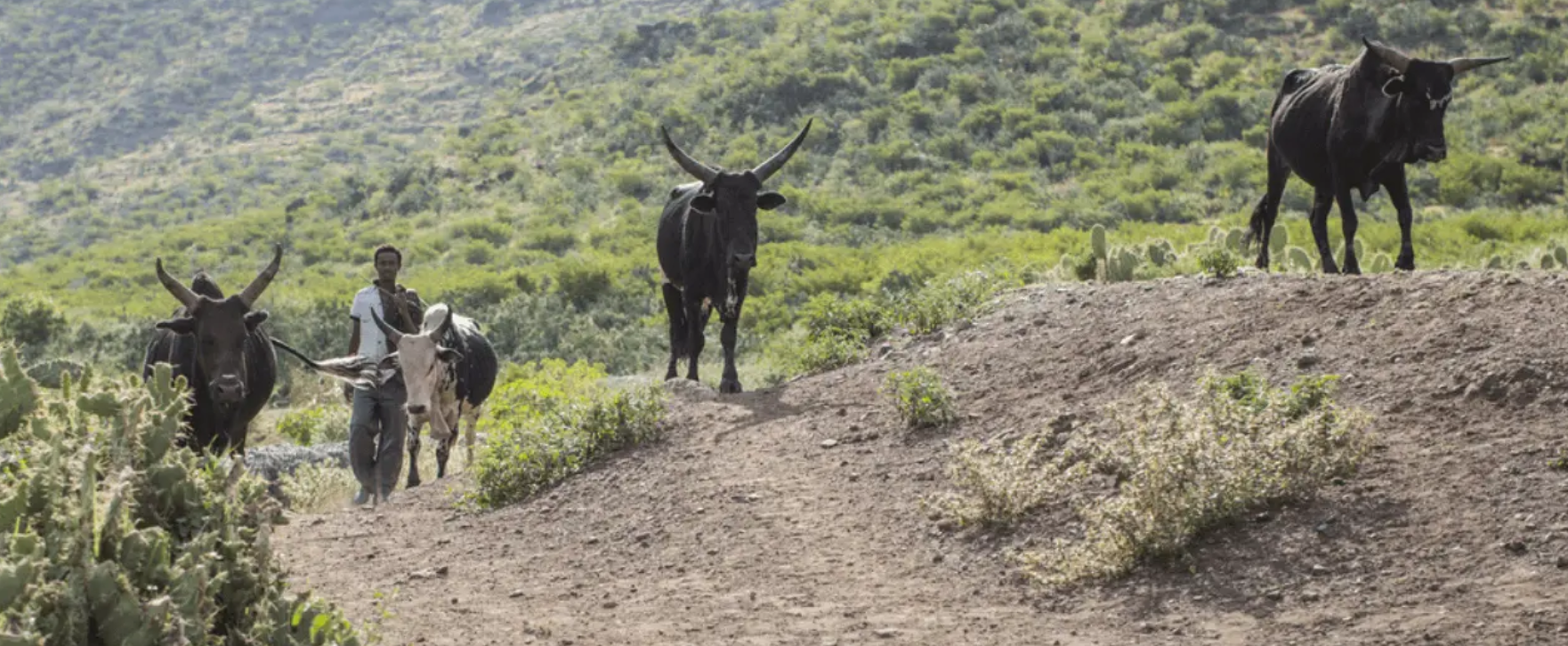
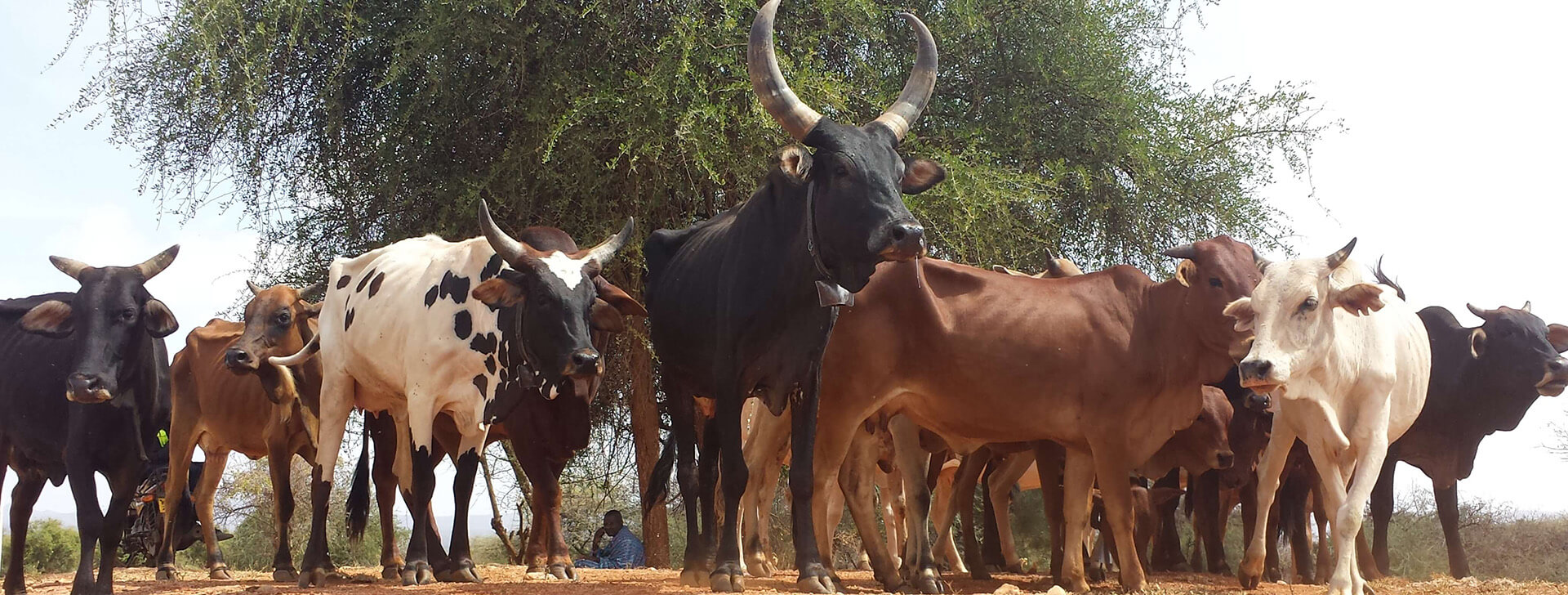
Rangelands cover up to 54% of the world's land surface, yet pastoralism remains one of the least discussed land uses. In Africa, it covers 43% of the continent and supports some 300 million people.
This interview brings three perspectives to the question. Dr Huyam Salih, Director of AU-IBAR, is joined by Monicah Yator, founder of the Indigenous Women and Girls Initiative in Kenya, and Jacob Lekaitogo, a pastoralist youth advocate from Laikipia. Journalist Jan Rübel moderated the discussion.
Together they examine climate adaptation, land tenure and mobility, access to finance, and the place of women and young people in pastoral economies. A common thread runs through their contributions: pastoralists are actors in Africa's development, not beneficiaries. Food for Transformation first published the interview as part of the International Year of Rangelands and Pastoralists.
Why Rangelands Matter for Food Systems Transformation in Africa
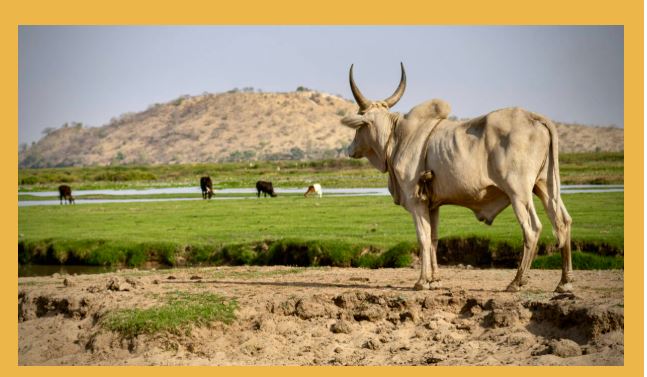
The article argues that rangelands are central to food systems transformation in Africa, and that sustainable livestock systems are key to securing their future. It sets out what rangelands are and what they do, who depends on them, what is putting them under pressure, and how policy and financing, including the LiveSys project, can respond.
The argument runs as follows. Rangelands cover up to 54 per cent of the global land surface, store around 30 per cent of global soil organic carbon and host up to 35 per cent of terrestrial biodiversity. Grazing-based systems support more than 200 million households, and livestock contributes to the livelihoods of roughly 80 per cent of poor households in Sub-Saharan Africa. Yet up to half of rangelands globally are degraded, driven by climate change, land-use conversion, infrastructure, restricted grazing access and weakened grazing management. Competition over land and limited recognition of tenure and mobility rights compound the pressure, particularly in the Sahel.
The article does not present livestock solely as a problem. It acknowledges that intensive systems account for 11 to 17 per cent of anthropogenic greenhouse gas emissions and that demand for meat and dairy is set to double by 2050 but argues that extensive pastoral systems are adapted to these environments and deliver ecosystem services. Its central point is that no one-size-fits-all approach exists: practices must be designed for site-specific contexts, involve women, youth and indigenous peoples, and address tenure and access. Climate-resilient, low-emission practices, including improved animal health, are cited as offering up to 30 per cent mitigation potential.
It closes on LiveSys and on the International Year of Rangelands and Pastoralists 2026 as an opportunity to strengthen the economic and political recognition of rangelands and pastoral systems.
Structure
Rangelands: extent, ecosystems and functions
Livestock, food security and livelihoods
Pressures on rangeland-based systems
Livestock systems and sustainability challenges
Sustainable livestock systems and rangeland management
Policy and financing support