

1st African Pastoral Markets Forum Concludes in Addis Ababa with Ministerial Communiqué on Transforming Africa's Pastoral Livestock Economy
Addis Ababa, Ethiopia — 17 July 2026
The 1st African Pastoral Markets Forum concluded in Addis Ababa on 17 July 2026 with the adoption of a ministerial communiqué committing African Union Member States to eight priority areas of action for transforming the continent's pastoral livestock economy. Held from 13 to 17 July 2026, the Forum affirmed that Africa's pastoral livestock economy is a strategic economic asset and a driver of food security, employment, trade, value addition, dryland resilience, climate adaptation and regional integration.
The Eight Ministerial Commitments
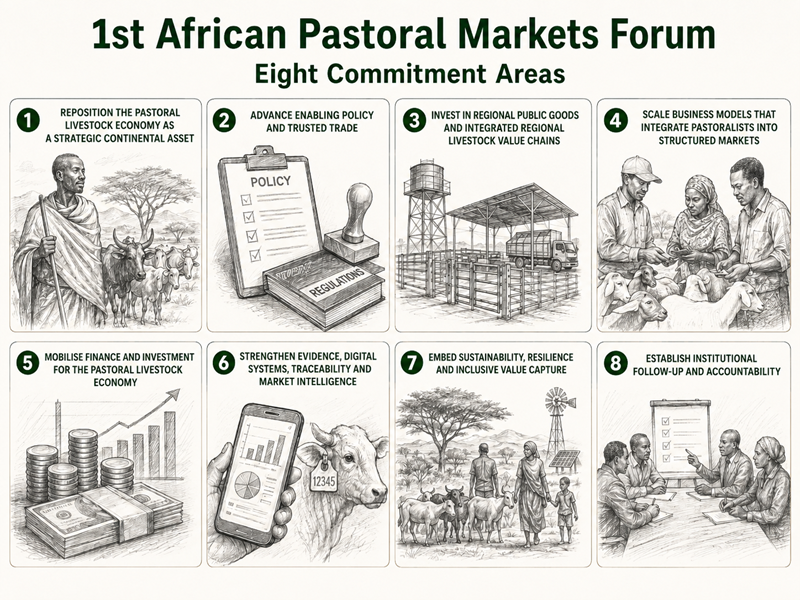
The Forum's defining outcome was a ministerial communiqué, adopted on 17 July 2026, in which Ministers responsible for livestock and pastoral development committed to eight priority areas of action.
First, to reposition the pastoral livestock economy as a strategic continental asset, elevating it within national agrifood investment plans, CAADP processes and AfCFTA trade priorities, and promoting a narrative that presents pastoralists as producers, suppliers, entrepreneurs and custodians of productive dryland systems.
Second, to advance enabling policy and trusted trade: progressively rationalising fees and levies along livestock corridors, simplifying movement and certification, strengthening SPS coordination, veterinary services, livestock identification and traceability, and facilitating safe, orderly, legal and negotiated cross-border trade and seasonal mobility.
Third, to invest in regional public goods and integrated regional livestock value chains, trade corridors, laboratories, quarantine facilities, holding grounds, water infrastructure and rangeland governance — with corridor development aligned to AfCFTA implementation.
Fourth, to scale business models that integrate pastoralists into structured markets, prioritising those with clear commercial logic, credible buyer relationships, transparent pricing and timely payment. Fifth, to mobilise finance and investment for the pastoral livestock economy, from working capital and trade finance to guarantees, livestock insurance and blended finance, with development finance institutions, commercial banks and investors invited to build credible investment pipelines with AU-IBAR, Member States and the Regional Economic Communities.
Sixth, to strengthen evidence, digital systems, traceability and market intelligence, making the economic value of pastoralism visible in data, including its contribution to agricultural GDP and the realities of informal trade.
Seventh, to embed sustainability, resilience and inclusive value capture: sustainable rangeland management, drought preparedness and anticipatory action, conflict-sensitive corridor governance, and deliberate measures to ensure pastoral women, men and youth capture a fair share of the value their economy creates.
Eighth, to establish institutional follow-up and accountability, translating the communiqué into a concise implementation and tracking matrix, with AU-IBAR coordinating post-Forum follow-up and sharing outcomes with African Union policy organs and the Regional Economic Communities.
A Collective Call to Action
The communiqué closes with a call upon Member States, Regional Economic Communities, pastoral communities, producer organisations, private enterprises, banks, development finance institutions, investors, development partners, and research institutions to work collectively to translate commitment into practice. Signatories included ministerial representatives of Uganda, Kenya, Nigeria, Somalia, and host country Ethiopia, who reaffirmed their collective determination to transform Africa's pastoral livestock economy into a competitive, resilient, inclusive, and sustainable driver of economic growth, food security, regional trade, climate adaptation, and Agenda 2063.
Participants commended the Government and people of the Federal Democratic Republic of Ethiopia for hosting the Forum. As the first of its kind, the African Pastoral Markets Forum now stands as a continental platform for evidence, business-model validation, policy alignment, investment facilitation and partner coordination, with the Addis Ababa communiqué as its first collective point of reference.
Convened by AU-IBAR through the African Pastoral Markets Development Platform (APMD) project, with the support of the Gates Foundation, the Forum was held under the theme “Positioning Africa's Pastoral Livestock Economy as a Strategic Economic Asset and Driver of Trade, Investment, Resilience and Regional Integration”. It brought together Ministers and senior government representatives from fourteen African Union Member States; Benin, Botswana, Burkina Faso, Cameroon, the Central African Republic, Chad, Ethiopia, Kenya, Namibia, Nigeria, Somalia, Sudan, Tanzania and Uganda, alongside Regional Economic Communities including IGAD and ECOWAS, pastoral community representatives, producer organisations, livestock enterprises, private-sector actors, financial and development finance institutions, development partners, and research and technical institutions.
Overview of the Forum
The Forum brought pastoral producers and community representatives into direct dialogue with governments, financiers, and market actors, and the discussions were notably practical and commercially focused. Delegates were clear that pastoral livestock markets are constrained not by a lack of potential, but by underinvestment in the systems that make markets work: enabling policy, organised business models, reliable data, appropriate finance, animal health and sanitary and phytosanitary (SPS) systems, trade facilitation, infrastructure, water, rangelands, energy, logistics and secure corridors.
The deliberations were anchored in the African Union Policy Framework for Pastoralism in Africa, Agenda 2063 and the Kampala CAADP Declaration, whose ambitions, among them tripling intra-African trade in agrifood products by 2035 in line with the African Continental Free Trade Area (AfCFTA) and mobilising USD 100 billion in public and private agrifood investment, frame the scale of the opportunity. The African Continental Free Trade Area was recognised as a historic opening for expanding intra-African livestock trade, and mobility, water, rangelands, secure corridors, animal health systems and traceability were affirmed for what they are: productive economic infrastructure.