

1st African Pastoral Markets Forum opens up a US$55 million pastoral livestock investment pipeline
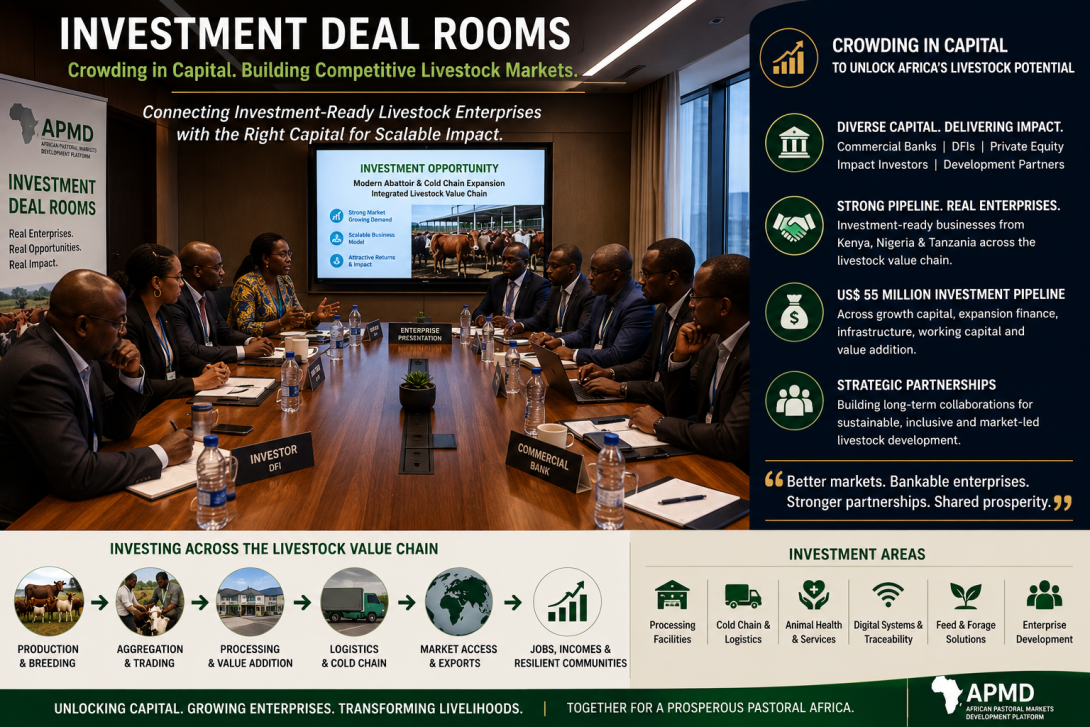
One of the defining features of the 1st African Pastoral Markets Forum was its deliberate shift from dialogue to action. Beyond the technical sessions and plenary discussions, the Forum curated dedicated investment deal rooms, as business-to-finance engagements, where promising livestock enterprises engaged directly with financiers to explore investment opportunities capable of accelerating the transformation of Africa's pastoral livestock economy.
A select group of enterprises from Ethiopia, Kenya, Nigeria and Tanzania presented investment-ready business cases and pitches to an audience comprising commercial banks, development finance institutions, private equity investors and development partners. Each enterprise outlined its business model, growth trajectory, capital requirements and expected development outcomes, while investors assessed opportunities based on their respective financing mandates and investment criteria.
Collectively, the enterprises presented an investment pipeline valued at approximately US$55 million, spanning commercial debt, equity investment, blended finance and catalytic capital. The financing requests reflected the diverse needs of Africa's livestock sector, including expansion of processing capacity, livestock aggregation systems, cold-chain infrastructure, digital traceability, feed production, and export market development.
The deal rooms reflected a growing recognition that Africa's pastoral livestock sector is evolving into an investable economic sector. The Forum emphasized on the need for stronger mechanisms to connect businesses with appropriate sources of capital. The deal rooms provided that bridge by creating a structured environment where entrepreneurs and financiers moved to substantive commercial discussions.
Importantly, the engagements acknowledged that no single financing instrument can address the varied investment needs of livestock enterprises. Commercial banks explored opportunities for working capital and expansion finance, development finance institutions considered longer-term investments that generate both financial and development returns, while impact investors and development partners examined opportunities to deploy concessional finance and technical assistance to de-risk commercially promising ventures. This diversity of financing options reflected the reality that building competitive livestock markets require a financing ecosystem rather than a single source of capital.
For participating enterprises, the sessions provided more than access to potential investors. They offered an opportunity to test investment propositions, receive feedback on business models and better understand investor expectations regarding governance, financial performance, market access and environmental and social standards. These exchanges are expected to strengthen the quality of future investment proposals while improving enterprises' readiness to access finance.
For investors, the deal rooms showcased a pipeline of businesses operating within one of Africa's fastest-growing agri-food sectors with a rising demand for livestock products across the continent, expanding opportunities under the African Continental Free Trade Area (AfCFTA) and increasing interest in regional value chains that continue to position livestock as an attractive investment destination. The Forum demonstrated that commercially viable enterprises already exist and that, with the right financial instruments and enabling environment, they can scale to serve both domestic and regional markets.
While the investment engagements initiated are expected to continue through due diligence and individual follow-up, the deal rooms, reinforced the Forum's broader objective of moving from evidence to execution. Over the preceding days, stakeholders had examined the economic potential of pastoral livestock, the importance of trusted market systems and the investments needed to strengthen competitiveness. The investment sessions translated those outcomes into tangible opportunities by presenting real businesses seeking real capital.