

AU-IBAR presents a ten-year plan for Africa's fisheries and aquaculture
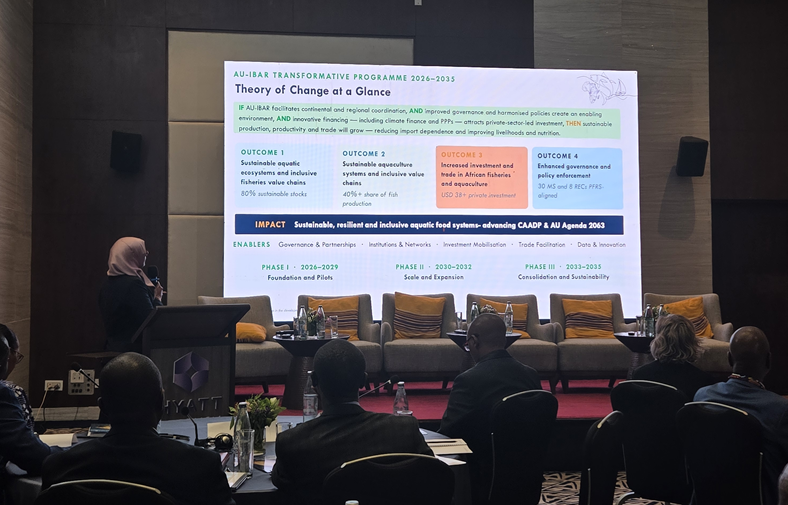
Addis Ababa, 22 October 2026 – AU-IBAR Director Dr Huyam Salih used the keynote address at the closing meeting of FishGov2 to present the Ten-Year Transformative Programme for Resilient and Sustainable Fisheries and Aquaculture (2026–2035), which ministers later endorsed.
"This is the closure of FishGov2," she said, “but it is the beginning of the transformation of fisheries and aquaculture.”
Built on a decade of reform
Dr Salih traced EU support to AU-IBAR from the first FishGov project (2014–2018) to FishGov2 (2021–2026). Both were anchored in the Policy Framework and Reform Strategy for Fisheries and Aquaculture in Africa, which guides AU-IBAR's work at the continental, regional and national levels. The framework covers seven policy areas:
-conservation and sustainable resource use;
-small-scale fisheries;
-aquaculture;
-responsible and equitable fish trade and marketing;
-regional and sub-regional cooperation;
-awareness and human capacity; and
-Africa's interests in high seas fisheries.
Climate resilience, gender and youth, and private sector investment run across all of them.
The main purpose of policy, she said, is to create an environment in which the private sector can thrive. She recalled the Ghanaian Minister's point that the sector's private sector is made up of fishermen and fisherwomen themselves.
The gaps that remain
Implementation has exposed the gaps that remain: degraded aquatic ecosystems under climate and human pressure, illegal, unreported and unregulated fishing, weak small-scale fisheries governance, limited access to seed, feed, technology and finance for aquaculture, high post-harvest losses linked to poor infrastructure, and few financial products suited to cooperatives and small businesses.
Africa remains heavily dependent on fish imports despite its water resources, and its consumption is half the global average. "We are importing jobs," she observed. The issue, she added, is affordability as well as availability, with direct consequences for nutrition security.
Four outcomes, three phases
The programme is built around four outcomes:
-
Conserved aquatic ecosystems and sustainable capture fisheries, with communities as guardians of their resources and better landing sites and markets for small-scale fishers
-
Unlocking the factors that limit aquaculture production
-
Stronger fish trade and value chains, including cold chains and trade corridors
-
Improved governance and policy enforcement, continuing the work of FishGov1 and FishGov2
It will run in three phases (2026–2029, 2030–2032 and 2033–2035), delivered through national and regional projects. Resource mobilisation for the first phase is under way. With AUDA-NEPAD support, two concept notes have been prepared to guide investment in capture fisheries and aquaculture. Under the first outcome, AU-IBAR already leads work on conserving aquatic biodiversity in the blue economy.
Who does what
Dr Salih stressed that AU-IBAR will facilitate and coordinate, not lead implementation. Regional Economic Communities will lead, with support to strengthen their capacity, while governments and the private sector implement. To avoid a double reporting burden, progress will be tracked through the existing CAADP Biennial Review.
The programme draws on the institutions and networks FishGov built: the African Union Centres of Excellence, the African Women Fish Processors and Traders Network (AWFishNet), AFRIFISH-NET and other platforms. Its enablers include partnership and coordination, investment with the private sector, trade facilitation, research and innovation, advocacy and knowledge management, and gender and youth inclusion.
Speaking the language of investment
She described it as a continental vision open to every partner, to be financed through domestic resources at government level alongside catalytic funds from partners, including climate finance. To bring in private investors, she said, the sector must speak in numbers: what an investor puts in and what the returns will be. She also called for stronger advocacy to show the socio-economic value of fisheries at national, regional, continental and global level.
Her request to partners was twofold: support a third phase of FishGov, and, until then, protect what has been achieved. "Between FishGov2 and FishGov3, we are all the guardians of the results," she said.