

From Continental Coordination to Field Action: Africa Advances Towards PPR Eradication
Addis Ababa, Ethiopia — 29 July 2026
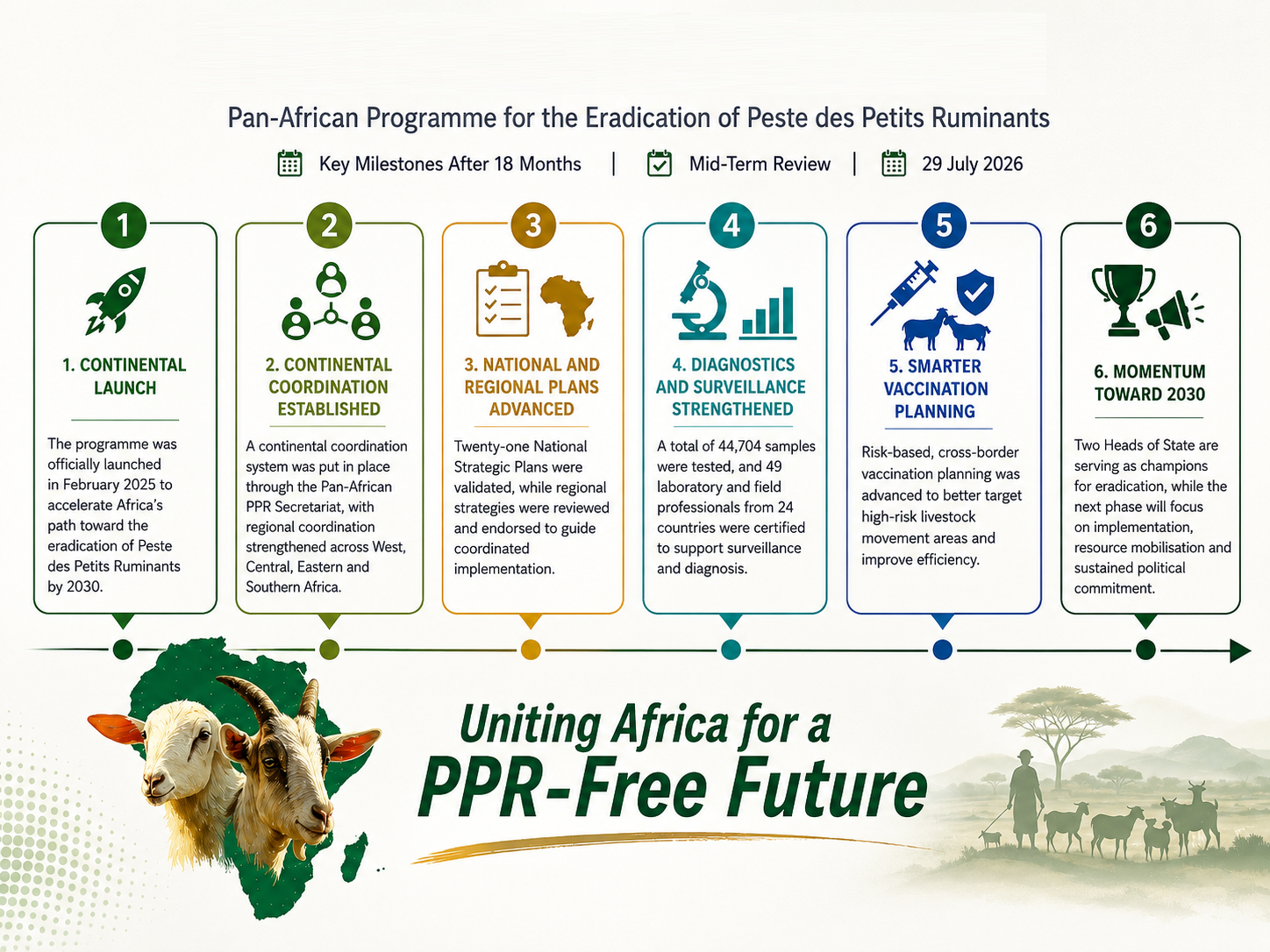
Eighteen months after the launch of the Pan-African Programme for the Eradication of Peste des Petits Ruminants, African countries and their partners are moving from continental commitments towards coordinated implementation.
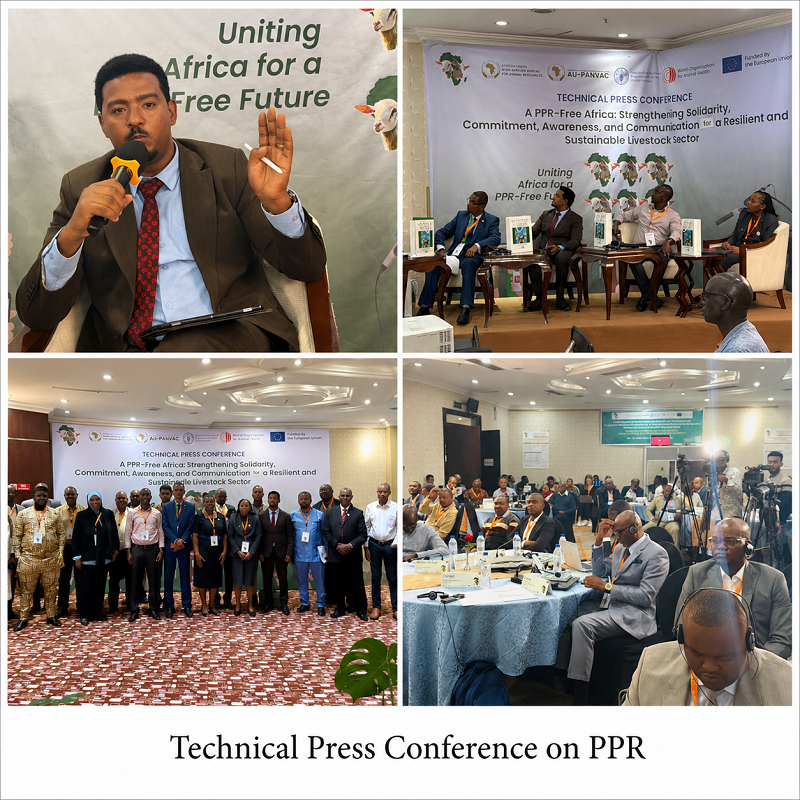
The programme’s mid-term technical press conference in Addis Ababa provided an opportunity to assess progress, identify persistent challenges and define the priorities for the next phase. The discussion showed that important foundations have been established, including stronger coordination structures, validated national plans, improved surveillance and diagnostic capacity, and more targeted approaches to vaccination.
It also delivered a clear message arguing that the next phase must translate these systems and strategies into sustained action in the field.
The programme is coordinated by the Pan-African PPR Secretariat, hosted by the African Union Inter-African Bureau for Animal Resources. It is supported by the European Union with EUR 8 million and implemented in partnership with African Union Member States, Regional Economic Communities, the African Union Pan-African Veterinary Vaccine Centre, the Food and Agriculture Organisation of the United Nations and the World Organisation for Animal Health.
A disease with consequences beyond animal health
Peste des Petits Ruminants is a highly contagious viral disease affecting sheep and goats. Of the African Union’s 55 Member States, 47 have reported the disease, placing a substantial proportion of the continent’s estimated one billion sheep and goats at risk.
In unprotected flocks, outbreaks can result in extremely high mortality. However, the impact extends far beyond the loss of animals.
For millions of rural and pastoral households, sheep and goats provide food, income and an accessible form of savings. Families often sell them to meet urgent needs such as school fees, medical expenses or food during periods of hardship. They are also important economic assets for women and young people.
When Peste des Petits Ruminants destroys a flock, it can remove a household’s financial safety net within a short period.
The eradication programme is therefore not simply a vaccination campaign. It is an investment in rural livelihoods, food security, livestock trade and stronger veterinary systems.
Establishing a continental coordination system
One of the programme’s most important achievements has been the establishment of a coordinated system linking national, regional and continental action.
The Pan-African PPR Secretariat provides a central platform for planning, reporting, evidence management and resource mobilisation. Regional Economic Communities are supporting countries to harmonise their approaches, while regional advisory structures facilitate technical review, peer learning and monitoring.
The Continental Advisory Group provides strategic oversight, supported by Chief Veterinary Officers, national coordinators, epidemiology networks and regional laboratory networks.
This coordination is essential because the disease spreads through livestock movement, pastoral routes, markets and cross-border trade. National action alone cannot stop transmission where animals and people move across shared borders.
As the African Union Inter-African Bureau for Animal Resources representative observed:
“The Pan-African PPR Secretariat provides the architecture needed for Africa to speak with one voice and move in one continental direction. PPR eradication is ultimately about protecting the livestock assets that millions of African families depend on for food security, income and resilience.”
Four Regional Economic Communities—covering West, Central, Eastern and Southern Africa—are now supporting PPR coordination as an established function. Regional strategies have been reviewed or endorsed, while cross-border planning is advancing in areas such as the Horn of Africa, the Mano River Basin and the Angola–Democratic Republic of Congo–Tanzania interface.
The emerging lesson is clear: countries may vaccinate independently, but eradication requires coordinated action across borders.
Turning national strategies into implementable plans
Progress has also been made in translating continental commitments into national action.
Twenty-one countries have validated National Strategic Plans for PPR eradication. These plans provide a structured basis for assessing the national disease situation, defining priorities, estimating costs and identifying responsibilities.
A validated and costed plan is more than a technical document. It enables ministries responsible for livestock and animal health to make a stronger case for domestic budget allocations. It also gives development partners and financial institutions a credible framework for co-financing implementation.
The Food and Agriculture Organization emphasised that stronger advocacy is now required to convert plans into funded programmes.
“One of the major challenges we face today is advocacy. We need to strengthen advocacy at all levels to secure increased funding and mobilise additional resources. With greater investment, countries will be better positioned to implement their programmes effectively and achieve their objectives.”
The next step is therefore to move from approved plans to financed and monitored action.
Strengthening surveillance and diagnostic capacity
The first 18 months have also strengthened the evidence required to guide eradication.
A total of 44,704 samples were tested using diagnostic kits supplied to 23 countries. Forty-nine laboratory and field professionals from 24 countries were certified in the safe shipment of infectious substances. In addition, 35 of 48 participating countries received training in the use of the African Union Animal Resources Information System.
Surveillance and risk-mapping activities are also under way in 28 countries, focusing on livestock corridors, border areas and epidemiological zones where transmission risks are highest.
These achievements are important because countries must be able to demonstrate the presence, reduction and eventual absence of the virus through reliable evidence. Disease freedom cannot be based on assumption. It must be supported by credible surveillance, laboratory testing and consistent reporting.
The World Organisation for Animal Health therefore stressed the importance of following the recognised stepwise pathway towards official disease-free status.
“The stepwise approach should guide countries towards the official recognition of their status. A common understanding and continued alignment among stakeholders will help Veterinary Services meet the required international standards and progress through each stage of the recognition pathway.”
Reliable data is therefore not a secondary administrative requirement. It is central to the eradication process.
Moving towards smarter vaccination
A major technical advance has been the shift from broad vaccination campaigns to more targeted, risk-based vaccination.
This approach is guided by “episystems”, areas defined by how the virus is maintained and transmitted through livestock production systems, animal movement, markets, and cross-border corridors.
By focusing on where the disease is most likely to circulate, countries can coordinate surveillance and vaccination across connected areas rather than relying only on administrative boundaries.
Cross-border planning is advancing in four priority areas: Moyale, the Great Lakes region, the Mano River Basin and the southern buffer zone.
Programme modelling indicates that this approach could significantly reduce the cost of vaccination. Blanket vaccination across the continent is estimated at approximately USD 408 million, compared with about USD 184 million for targeted vaccination based on epidemiological risk.
Better targeting can therefore reduce costs while improving the effectiveness of disease control.
However, successful vaccination also depends on the availability of quality-assured vaccines, reliable diagnostics and effective delivery systems.
The African Union Pan African Veterinary Vaccine Centre highlighted this requirement:
“To eradicate Peste des Petits Ruminants, we need to produce high-quality vaccines and ensure the availability of specific and sensitive diagnostic tests. These are essential for surveillance, early detection and effective disease control.”
Its work on vaccine quality assurance, diagnostic kit production, and innovation is helping to build long-term African capacity for disease eradication.
Key lessons from the discussion
The panel discussion identified several lessons that should guide the next phase.
First, coordination structures must lead to clear and accountable decisions. Meetings and advisory bodies are valuable only when agreed actions have responsible institutions, realistic deadlines, and mechanisms to address delays.
Second, technical preparedness must be matched by timely financing and procurement. Plans, expertise and tools cannot produce results when funding is delayed or critical supplies arrive after the appropriate vaccination or surveillance period.
Third, vaccines, diagnostic kits, reagents and transport logistics must be planned well in advance. Peste des Petits Ruminants is time-sensitive, and implementation delays allow the virus to continue spreading.
Fourth, national ownership will determine the pace of progress. Continental and regional organisations can coordinate, provide standards and mobilise technical support, but implementation ultimately depends on national Veterinary Services, government leadership and sustained domestic financing.
The European Union described its contribution as catalytic:
“We provide the initial investment needed to launch, support and scale up eradication efforts. However, lasting success cannot depend on external support alone. It requires sustained domestic commitment, national ownership and continued investment by African countries.”
The Government of Ethiopia echoed this message and called for stronger collaboration among Member States, Regional Economic Communities and development partners.
“The European Union has demonstrated important leadership through catalytic funding, but it cannot carry this responsibility alone. Stronger domestic commitment, regional cooperation and additional international support will be required to eradicate Peste des Petits Ruminants.”
The next phase: delivering results at scale
The first 18 months focused largely on establishing the institutional, technical and planning foundations for continental eradication.
The next phase must demonstrate that these foundations can deliver measurable results.
Priority actions include implementing National Strategic Plans, completing risk maps, expanding cross-border surveillance, synchronising vaccination campaigns, strengthening laboratory capacity and improving reporting across national, continental and international systems.
Countries must also continue to progress through the recognised eradication pathway: understanding the disease situation, controlling transmission, demonstrating the absence of the virus, and securing official recognition of freedom.
Resource mobilisation will remain central. The EUR 8 million provided by the European Union was not intended to cover the total cost of eradication. Rather, it has helped establish the coordination, evidence, quality-assurance and planning systems required to make larger national and partner investments more effective.
The economic case for eradication is strong. Programme estimates indicate a global benefit-cost ratio of 33.8 to one and potential net benefits of approximately USD 74 billion over 15 years.
However, the clearest measure of success will be seen at household level: a family that does not lose its flock, a pastoralist who can continue trading, a woman who retains a productive asset and a country able to participate in safer regional livestock markets.
Africa’s PPR eradication programme has moved beyond its launch phase. It now has stronger coordination, national and regional plans, improved surveillance and diagnostic systems, and a more efficient approach to vaccination.
The pathway towards a PPR-free Africa by 2030 is increasingly clear. The challenge now is to convert this progress into sustained field implementation, stronger national investment and the permanent interruption of virus transmission.