

Liberia Advances Toward PPR Eradication: National Stakeholders Validate Updated Strategy for 2025-2030
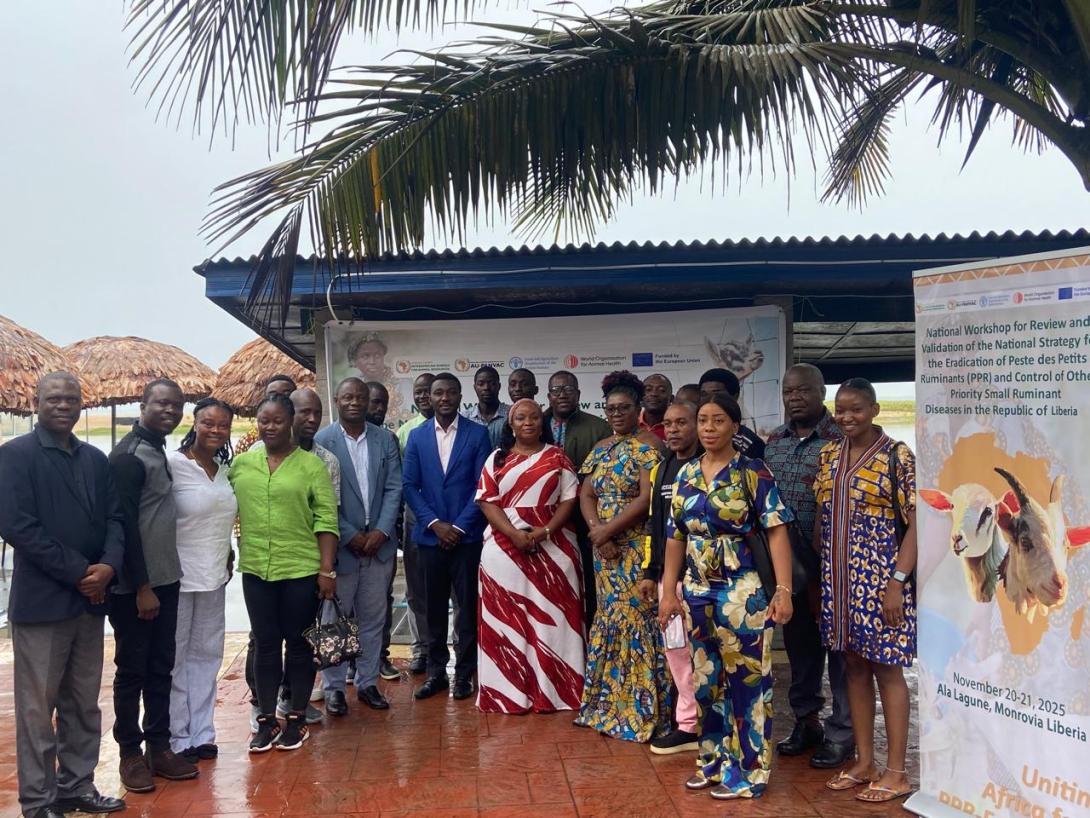
Liberia has taken a significant step toward strengthening its national animal health system and aligning with regional and global frameworks for Peste des Petits Ruminants (PPR) eradication. From 20-21 November 2025, a high-level national workshop was held at the Lagune Hotel in Monrovia to review and update the country’s National PPR Eradication Strategy for the period 2025-2030. The event gathered 34 experts and decision-makers from key ministries, national institutions, and development partners.
Ahead of the workshop, on 19 November, the Regional PPR Coordinator, Dr Perdita Hilary Lopes, and a representative of the Chief Veterinary Officer paid a courtesy call to Her Excellency Madame Zogbo Luther, Assistant Minister for Technical Services of the Ministry of Food and Agriculture. She welcomed the mission and confirmed her attendance at the opening ceremony, demonstrating strong political support for PPR eradication efforts.
The workshop opened with prayers, followed by remarks from the CVO, Dr. Garmie Voupawoe. The keynote address was delivered by the Regional Coordinator on behalf of the Director of AU-IBAR. The address highlighted Liberia’s need to align its strategy with:
• the Global FAO-WOAH PPR Eradication Programme,
• the Pan-African PPR Eradication Programme (PAPEP),
• and the ECOWAS Regional Roadmap.
The statement underscored priority actions including risk-based surveillance, structured vaccination, strong laboratory capacity, effective communication and stakeholder involvement, and sustainable financing mechanisms. The speech also underscored the importance of Liberia contributing at least 30% of the overall budget required for PPR eradication. The Assistant Minister expressed her appreciation for AU-IBAR’s continued collaboration in strengthening the livestock sector and conveyed her anticipation for the finalisation of the NSP with the revised budget, which will enable the Ministry to determine the level of national resources to allocate toward PPR eradication.
She further called on all stakeholders to reinforce early warning systems to ensure timely detection of animal diseases. With these remarks, she officially declared the workshop open.

Mrs Zobgo Luther participated in the workshop for approximately an hour, gaining firsthand insight into the technical discussions.
Participants represented a broad cross-section of national expertise comprising surveillance officers, laboratory specialists, researchers, animal production officers and wild life officers, all from various institutions including : Ministry of Agriculture, EPA, Ministry of Health, Wildlife Authority, and academia
Working groups were formed to review expert feedback and revise key chapters of the strategy, focusing on:
• epidemiological situation and surveillance system,
• laboratory diagnosis and quality assurance,
• vaccination and prevention plans,
• communication and community engagement,
• resource mobilisation,
• a stage- based results framework aligned with PMAT indicators
On 21 November, working group rapporteurs presented their updatedreviews. The Regional Coordinator, Dr. Perdita Hilary Lopes, then provided further technical guidance on strengthening the results framework, reinforcing the monitoring and evaluation system, and adjusting the budget structure to match stage-based PPR eradication milestones through 2030.
While substantial progress was achieved, a few components could not be fully developed due to time constraints notably the national contingency plan, which will be drafted and incorporated into the final version of the strategy.
Other priority areas highlighted for completion include:
• improving surveillance design and risk-stratification,
• integrating gender and youth dimensions,
• strengthening communication and behavioural-change strategies,
• clarifying national funding commitments,
• and refining budget lines according to PMAT stage-progression.
Review of Liberia’s updated National PPR Strategy marks a major milestone in the country’s journey toward the continental target of eradicating PPR by 2030. With strengthened alignment to global and regional frameworks, Liberia is better positioned to implement a coordinated, well-resourced, and results-driven roadmap.
Through continued collaboration with ECOWAS-CRSA, AU-IBAR, FAO, WOAH, and national stakeholders, Liberia is building the solid institutional and technical foundations needed to protect rural livelihoods, improve food security, and contribute to a PPR-free West Africa.