
Mali strengthens its PPR eradication strategy to protect flocks and livelihoods
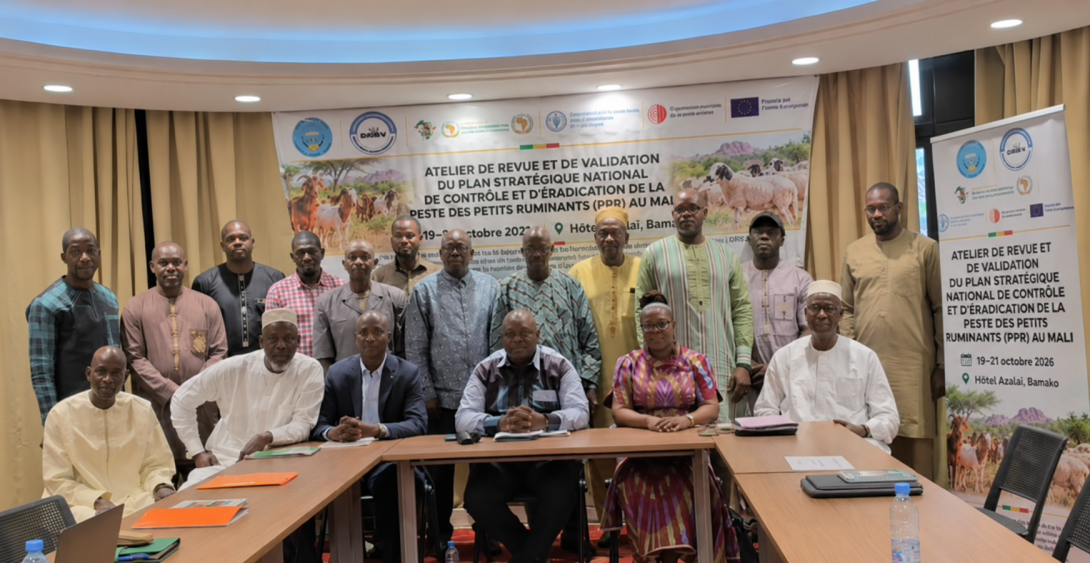
Bamako, Mali From 19 to 21 October 2026, national authorities and their partners met at the Azalaï Hotel to review and update the National Strategic Plan for the control and eradication of peste des petits ruminants (PPR). The workshop enabled agreement on priority revisions to strengthen surveillance, diagnosis, vaccination, financial planning and implementation monitoring.
With a population of 58.3 million small ruminants, Mali holds a major position in livestock production in West Africa. Protecting these sheep and goats against PPR is essential for household incomes, food security and the resilience of pastoral and agropastoral communities. The size of this livestock population and cross-border animal movements also make Mali a key player in eradicating the disease in the subregion.
Organised by the Ministry of Livestock and Fisheries, with support from AU-IBAR through the Pan-African PPR Secretariat (PAPS) and funding from the European Union, the meeting aimed to provide Mali with a coherent, evidence- and risk-based, costed and operational national framework. The discussions advanced the revision of the plan, which still requires consolidation and further technical review before finalisation.
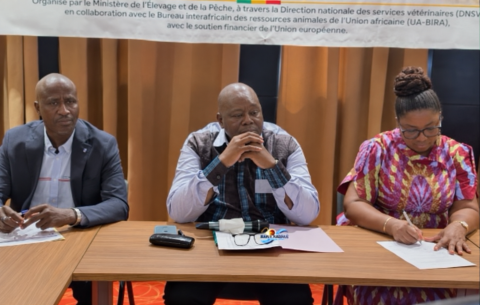
At the opening of the workshop, Dr Boubacar Bass, Technical Adviser to the Ministry of Livestock and Fisheries, recalled the importance of livestock in the national economy and reaffirmed Mali’s commitment to eradicating PPR by 2030. He emphasised that this commitment remains despite the public funding constraints facing the country.
Speaking on behalf of the Director of AU-IBAR, Dr Perdita Hilary Lopes, Regional PPR Coordinator for West Africa, highlighted Mali’s central role in small ruminant production and mobility. Strengthening its strategy therefore represents both a national priority and an important contribution to eradication efforts in West Africa. She reaffirmed AU-IBAR’s readiness to support the country in aligning its plan with the pan-African and global frameworks.
Participants examined the main technical, institutional, operational and financial gaps identified during the review of the plan. Group work and plenary discussions enabled agreement on the proposed changes and the incorporation of those for which the necessary information was available.
Surveillance and diagnosis were central to the discussions. Recommendations focused particularly on improving sample transport, laboratory quality assurance, turnaround times for communicating results and feedback mechanisms. Strengthening outbreak investigations and reporting should also help to better guide interventions.
Regarding vaccination, discussions focused on priority populations, annual targets, forecasting vaccine requirements, procurement, the cold chain and field distribution. Participants also emphasised the importance of tracking vaccine use and post-vaccination monitoring to assess coverage and immunity in animal populations.
These interventions must be adapted to livestock production systems, animal movements, transhumance corridors, markets and border areas.
Mali also has a legal framework supporting PPR control, notably Law No. 01-022 of 31 May 2001 and Decree No. 01-0339/P-RM of August 2001, which provide for disease notification, compulsory vaccination and outbreak investigation. This legal foundation is an asset for ensuring stakeholder accountability, mobilising resources and supporting the implementation of interventions. Mali’s experience thus offers a useful lesson for the subregion: technical guidance benefits from being supported by clear and effectively enforced regulatory provisions.
The workshop highlighted the need to link each activity to clearly defined institutional responsibilities, measurable indicators, annual targets and realistic costs.
Distinguishing between government and partner contributions should help clarify funding gaps and better guide resource mobilisation. Costed annual work plans will be essential to translate strategic directions into feasible interventions.
Participants also recommended continuing to use the PPR Monitoring and Assessment Tool (PMAT) to document evidence and assess progress towards eradication.
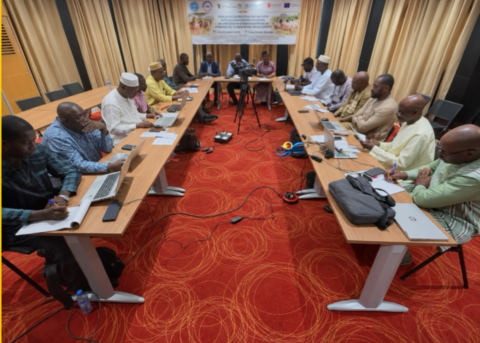
The meeting brought together national authorities, representatives of veterinary services, laboratories and regions, as well as AU-IBAR, PRAPS-2, FAO, ILRI, APESS, pastoral networks and livestock farmers’ organisations.
Their contributions helped bring technical guidance closer to realities on the ground, particularly the challenges of delivering veterinary services and producers’ needs. PRAPS-2’s participation also ensured continuity with previous support for the development and updating of the national plan.
Discussions highlighted opportunities for collaboration with community organisations such as ADICOM, whose networks could contribute to awareness-raising, livestock farmer mobilisation and coordination with veterinary services. These opportunities will need to be explored further, particularly in areas affected by insecurity or that are difficult to access.
Flock mobility and shared animal health risks make cooperation with neighbouring countries essential. The workshop therefore emphasised cross-border surveillance, information sharing and vaccination coordination in shared high-risk areas.
Aligning Mali’s plan with regional, continental and global frameworks should help link national investments to collective eradication efforts. For communities dependent on livestock, the expected benefits are improved access to prevention and veterinary services, as well as better protection of the sheep and goats that contribute to their incomes, food and savings.
The National Directorate of Veterinary Services must now incorporate the remaining comments, share the consolidated document with participants and submit it for further technical review, then to the relevant departments for approval.
At the closing, Prof. Boubacar Bass reiterated the Ministry’s thanks to AU-IBAR and called for adherence to the agreed timetable for submitting the revised document.
Follow-up actions will focus on preparing costed annual work plans, clarifying funding, strengthening coordination with partners and establishing measurable monitoring. Appointing a drafting team and assigning clear responsibilities will be crucial to completing the plan and preparing to translate it into action on the ground.