

Ouagadougou hosts high-level regional training on ARIS-3: four intense days to modernize veterinary data collection in West and Central Africa
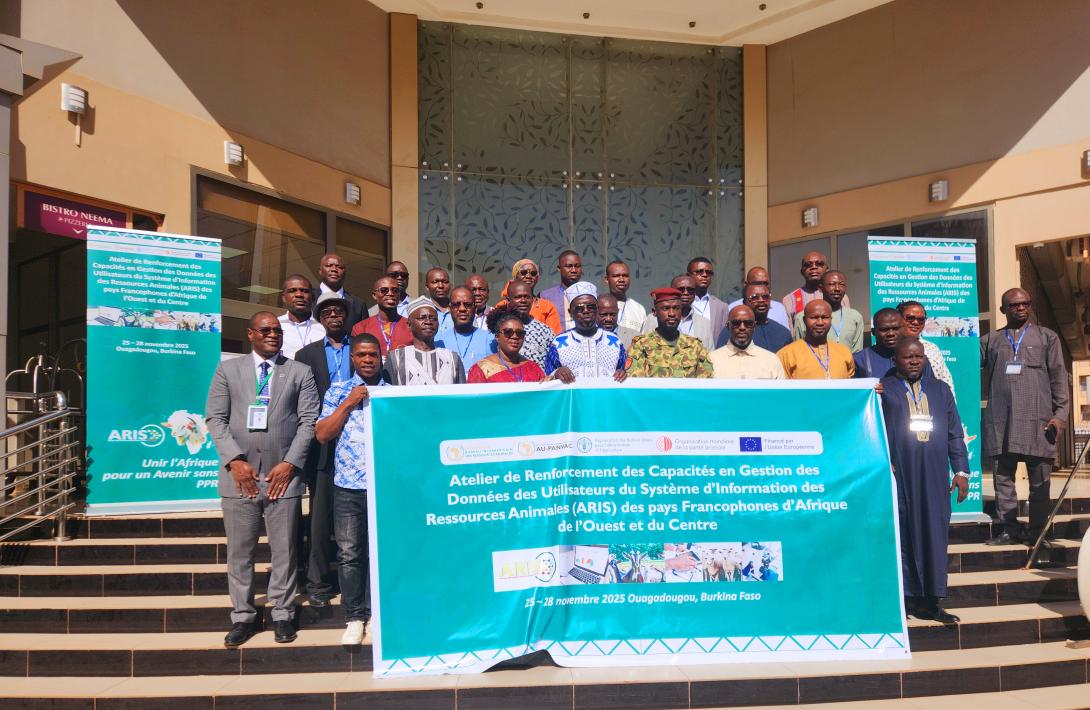
Ouagadougou, Burkina Faso, November 25-28, 2025 For four days, the Burkinabe capital brought together experts from 14 French-speaking countries in West and Central Africa, alongside the FAO, OMSA, ECOWAS-CRSA, CEEAC, and several national institutions for regional training dedicated to the launch of ARIS-3, the new generation of the Animal Resources Information System developed by the African Union through AU-IBAR.
This meeting marks a decisive step in the digitization of health surveillance, an essential pillar in the eradication of Peste des Petits Ruminants (PPR) and transboundary animal diseases, which cause more than $1.45 billion in losses each year and affect the livelihoods of more than 300 million people on the continent.
ARIS-3: a strategic tool for decision-making and health surveillance. With its modernized interface, which is faster and accessible on computers, tablets, and smartphones, ARIS-3 now enables:
-
the harmonized collection of health, zootechnical, and commercial data,
-
advanced surveillance of RSP, Rift Valley fever, avian influenza, bluetongue, and other priority diseases,
-
the creation of dashboards,
-
the implementation of interoperability with WAHIS (OIE) and EMPRES-i (FAO),
-
improved vaccine planning and emergency response,
-
increased efficiency in national reporting requirements.
On behalf of the Director of AU-IBAR, Dr. Hiver Boussini, Animal Health Coordinator, reiterated:
“ARIS-3 is not just software: it is a catalyst for informed decision-making, a structuring tool for food security and for the eradication of PPR by 2030.”
He emphasized that the system is aligned with the continental frameworks AHSA, LiDeSA, PPDA, CAADP, and Agenda 2063.
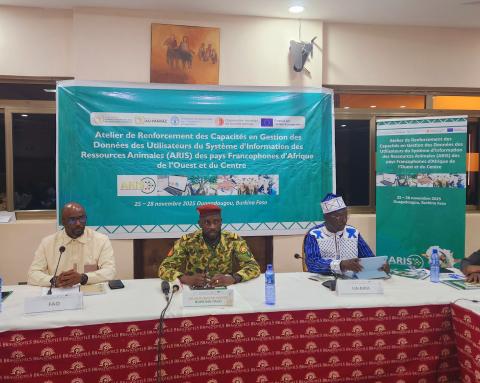
🔹 Dr. Aboubacar NACRO, representing the Deputy Minister in charge of Animal Resources in Burkina Faso, praised the use of statistical data collection through ARIS, a strategic tool for improving surveillance, supporting vaccination, and strengthening food sovereignty.
🔹 FAO Representative Dr. Mohamed Sylla, Emergency and Resilience Coordinator, emphasized the importance of data digitization in achieving the global goal of a PPR-free Africa by 2030.
With its modernized interface, animal health modules, and interoperability with WAHIS and EMPRES-i, ARIS positions Africa at the forefront of health intelligence.
During the four-day workshop, participants-including epidemiologists, veterinarians, PPR focal points, data managers, and surveillance officers-strengthened their skills in:
-
advanced system configuration and user management,
-
customization of animal health modules
-
validation and quality assurance procedures,
-
dashboard generation.
Participants praised the workshop's practical approach, highlighting a better end-to-end understanding of the data lifecycle, an increased ability to solve technical problems, and strengthened collaboration between neighboring countries.
One participant spoke on behalf of the group:
"This training finally gives us the tools and vision we need to harmonize our data and modernize our surveillance. We are leaving with concrete skills that are ready to be transferred to our regional and field teams.“ He continued, ”We are determined to become ARIS-3 ambassadors in our countries. This system is changing the way we think about, collect, and use health data."
The closing ceremony was presided over by the Deputy Minister in charge of Animal Resources, who came to personally congratulate the participants and mark Burkina Faso's commitment to the digital transformation of animal health.
In his speech, he said:
”ARIS-3 is a strategic tool for strengthening surveillance, supporting vaccination, and consolidating the food sovereignty of our countries. I urge you to implement this system as soon as you return, because without reliable data, we cannot build effective policies or respond quickly to epidemics."

The Minister also praised the technical support provided by the African Union, FAO, and OMSA, as well as the financial support of the European Union, a major partner in the eradication of PPR.
His strong message of encouragement created a solemn moment, closing the session on a note of renewed commitment.
Unanimous recognition from participants: “An essential and timely training.”
At the end of the four days, participants unanimously recognized:
-
the educational and technical quality of the program,
-
the importance of strengthening the training cascade down to the regional and district levels,
-
the need to standardize national surveillance protocols,
-
the structuring role of ARIS-3 in achieving the 2030 goals for PPR,
-
the importance of strengthening regional cooperation between ECOWAS and ECCAS.
The Ouagadougou workshop marks the beginning of a new era for health governance in Africa:
-
an integrated, modern, and interoperable system,
-
better data quality for rapid disease detection,
-
increased support for national and regional veterinary policies,
-
a direct contribution to a resilient and prosperous Africa, in line with Agenda 2063.
In conclusion, Dr. Hiver Boussini summarized the collective vision:
“ARIS-3 is the backbone of African health intelligence. Together, we are building a future where decisions are based on reliable data, where epizootics are detected earlier, and where communities' livelihoods are better protected.''