

Partners and AU mark the close of FishGov2 and turn to what comes next
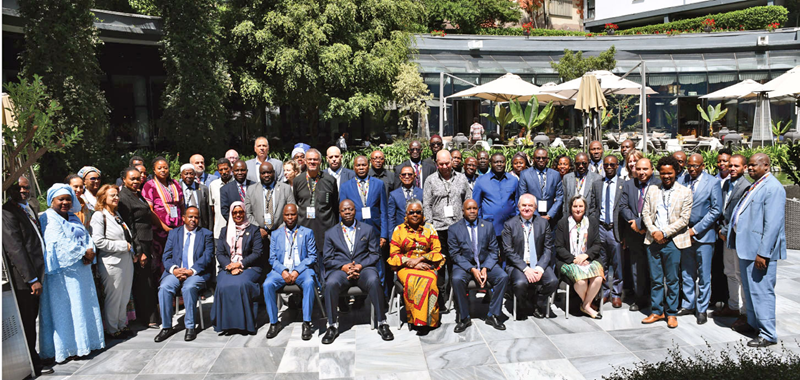
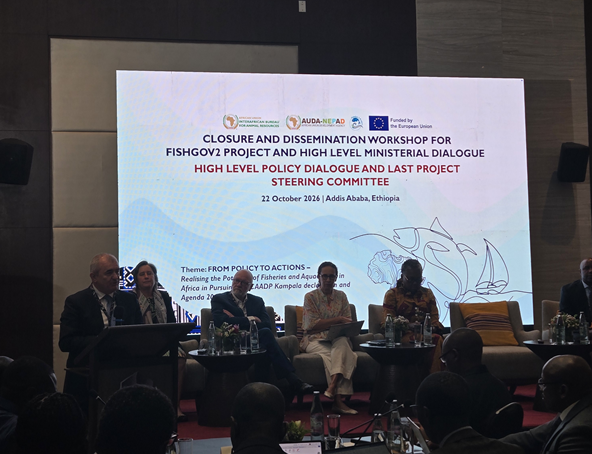
Addis Ababa, 22 October 2026 – The High Level Policy Dialogue and the sixth and final Project Steering Committee of FishGov2 opened at the African Union Commission with a clear call from partners: African institutions and governments must now secure, own, and scale the results of the last six years.
The meeting followed a two-day Project Technical Committee held on 20 and 21 October. Dr Harsen Nyambe, Acting Director of Sustainable Environment and Blue Economy and Agriculture and Rural Development at the African Union Commission, chaired the opening session.
The second phase of the Fisheries Governance Project (FishGov2), "Enhancing Sustainable Fisheries Management and Aquaculture Development in Africa: A Programme for Accelerated Reform of the Sector", is funded by the European Union and implemented by the African Union Inter-African Bureau for Animal Resources (AU-IBAR) with the African Union Development Agency (AUDA-NEPAD) and the World Organisation for Animal Health (WOAH). It closes at the end of October 2026.
European Union: progress is real, but not automatic
Speaking for the European Union Delegation to the African Union, Head of Cooperation Mr Gianlucca Azzoni described FishGov2 as partnership in practice. The project, he said, had connected continental ambitions with practical cooperation on governance, evidence, institutional coordination and policy support. He noted that the EU had accompanied the reform process for almost 15 years.
One lesson stood out: lasting change depends on political commitment, institutional capacity, regulatory coherence and ownership by institutions and stakeholders. As the programme closes, he said, the questions are what has changed in countries, and how those gains can be sustained through continental, regional and national action.
He was candid that the EU is not yet in a position to commit to future support, as it is still finalising its framework and priorities for the coming years. He indicated that future partnerships are likely to rest on stronger political ownership, shared African and European interests, and closer links to trade and investment cooperation. Strong governance, sustainable value chains and an enabling environment for responsible investment would remain important. He urged participants to treat the closure as a moment to consolidate lessons, not an ending.
FAO: Africa's protein gap is growing
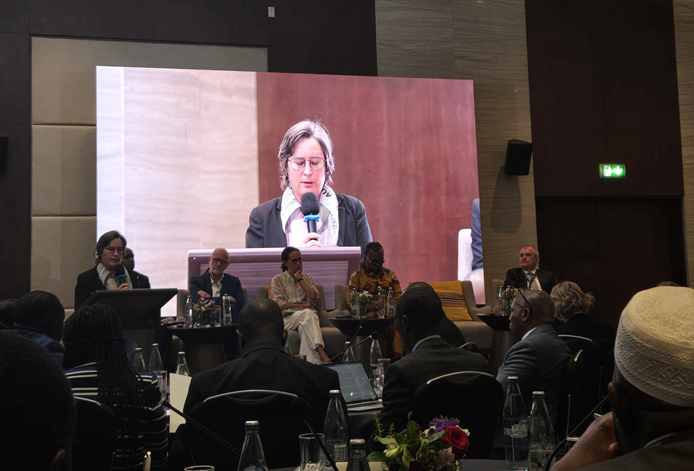
Dr Tarub Bahri, Senior Fisheries and Aquaculture Officer at the Food and Agriculture Organisation of the United Nations (FAO) Regional Office for Africa, recalled the strong African presence, at ministerial level, at the 37th session of the FAO Committee on Fisheries last year. She then set out the scale of the challenge.
Africans eat about 9 kg of aquatic food per person a year, the lowest of any region and half the global average. Even so, aquatic foods supply close to a fifth of the animal protein available on the continent, and much more along coasts, rivers and lakes. Demand is rising with population, and supply is struggling to keep pace. Many marine stocks are overexploited, there are large data gaps for inland fisheries, and the continent imports more fish than it exports.
Capture fisheries alone will not feed Africa's future, she said. Aquaculture has grown by close to 8 per cent a year since 2000, yet Africa still produces only about 2 per cent of global output, mostly from small-scale farmers. Egypt, Nigeria, Ghana, Uganda and Zambia lead the way. FAO and the African Union are discussing a partnership to develop aquaculture, supported by FAO guidelines for sustainable aquaculture, a spatial planning method to identify high-potential areas, and a framework to assess investment opportunities.
She noted FAO support for stock assessment training for African scientists at the University of Cape Coast in Ghana, a toolkit being developed to improve information on the state of stocks, and national management efforts in countries such as Kenya, Madagascar, Senegal and Uganda. Value chains with fewer losses, better handling and sound infrastructure, and a fair place for women and young people, were the cornerstone, with the Small-Scale Fisheries Guidelines providing the roadmap for equity and inclusion.
WOAH: commitment beyond the project
Mr Patrick Bastiaensen, Programme Officer at WOAH, spoke on behalf of the Director General. He recalled a partnership with the African Union and the EU that stretches from the fight against rinderpest in the 1970s to today's campaign against peste des petits ruminants. WOAH sets the international standards for aquatic animal health and trade, and African common positions have shaped that work.
He assured that WOAH will keep working with Member States to make aquatic animal production safer, more sustainable, healthier and more competitive in trade, whether or not FishGov continues in its current form.
AUDA-NEPAD: from project to permanent capability
On behalf of the AUDA-NEPAD Chief Executive Officer, Dr Bernice Mclean reminded the meeting that the project was born in turbulent waters, starting in January 2021 at the height of the COVID-19 pandemic. Teams had to find new ways to connect institutions and keep continental cooperation moving.
When the project began, per capita fish availability in Africa was estimated at 9.4 kg; recent reporting puts it at around 9.1 to 9.2 kg. Africa now has the fastest-growing aquaculture sector in the world, but climate change is putting pressure on ecosystems, infrastructure and livelihoods. She set out three messages. FishGov2 had strengthened Africa's ability to understand the sector and act on evidence. It had shown the value of African institutions working together, with AU-IBAR's specialised mandate and AUDA-NEPAD's implementation role reinforcing each other. And its end must become a transition to implementation at scale.
She said its legacy should be judged by what African institutions can now do for themselves. Aquatic systems do not follow administrative borders, she noted, so national, regional and continental action must reinforce one another. She invited the EU and other partners to help shape a successor that combines local impact, regional connectivity and continental coherence.
African Union Commission: endorse the next step
H.E. Moses Vilakati, Commissioner for Agriculture, Rural Development, Blue Economy and Sustainable Environment, reminded participants that AU-IBAR is part of the African Union Commission. He recalled that the project delivered despite the pandemic and a 16-month no-cost extension, guided by a Steering Committee drawn from the Specialised Technical Committee's elected bureau.
He listed its main results: operationalising the African Fisheries Reform Mechanism, a continental fisheries and aquaculture data platform, stronger institutional capacity, active stakeholder networks, and common African positions in global fora. Africa's per capita fish consumption remains less than half the global average, and the continent's share of global aquaculture is very small. He invited ministers to endorse the ten-year programme as the vehicle to carry these gains forward under Agenda 2063, the Africa Blue Economy Strategy, the African Continental Free Trade Area and the Kampala CAADP Declaration.
Host country: now it is our turn
In the host country's opening statement, delivered on behalf of H.E. Fikru Regassa, State Minister for Livestock and Fishery Resources Development, Ethiopia described how placing fisheries at the centre of its food sovereignty agenda had lifted national production and per capita consumption. "This did not happen by accident," the statement said.
Continental frameworks, it argued, must now reach national investment plans, budgets and policy decisions. FishGov2 had provided the tools, but tools do not implement themselves. "Officials and experts have done their work. Now it is ours." Ethiopia called on ministers to endorse the framework, commit to the sustainability and exit strategy, and instruct their ministries to carry the agenda beyond October 2026, and affirmed its readiness to continue as a partner and as host of the African Union.