

PPR Regional Capacity Building Workshop on Advancing National PPR Eradication Programmes and the RAG meeting

Today, in Addis Ababa, Ethiopia, officially opened the Regional Capacity Building Workshop on Advancing National PPR Eradication Programmes and the Regional Advisory Groups (RAG) Meeting, organised by the Pan-African Secretariat for the Eradication of Peste des Petits Ruminants (PAPS), hosted by AU-IBAR, in collaboration with the Government of Ethiopia and with the financial support of the European Union.
Over the next five days, 88 experts from 44 African countries will work together to strengthen national capacities in surveillance, vaccination, strategic planning and regional coordination, equipping Member States with practical tools to accelerate the implementation of National Strategic Plans and achieve the shared vision of a PPR-free Africa.
The opening session delivered a clear and unified message: Africa has the technical expertise, partnerships and strategic frameworks needed to eradicate PPR. The challenge is no longer planning it is accelerating implementation.
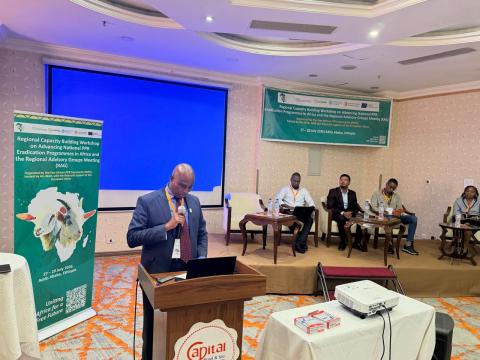
The representative of AU-IBAR emphasised that notable progress has been achieved. National strategies have been developed, surveillance has been strengthened, vaccination has expanded, governance structures have been established, planning and monitoring tools have been developed, regional networks have evolved, technical knowledge has deepened, commitment to eradication has grown and the common vision has solidified. He stressed that the priority is no longer developing strategies, but converting strategies into sustainably funded, sequenced and accountable national programmes, strengthening national and regional coordination, and translating political commitments into measurable results. He called for stronger country ownership and coordinated action to deliver the shared vision of a PPR-free Africa
The representative of the European Union reaffirmed its long-term commitment to supporting Africa's eradication efforts, while stressing that PPR eradication cannot be achieved with resources from external partners alone. It will be achieved by sustained investment from countries, stronger Veterinary Services, stronger stakeholders', including livestock keepers and strong regional cooperation. The EU also highlighted the significant financing challenge, noting that although it has already committed a €50 M grant, and a further €40 M through blended financing, this represents only a fraction of the estimated US$5.3 billion required to eradicate PPR across the continent.

The Representative of the Government of Ethiopia, on behalf of the State Minister of Livestock reaffirmed Ethiopia's commitment to working alongside African countries and international partners to strengthen Veterinary Services, build regional capacity and accelerate eradication through collective action and shared responsibility.
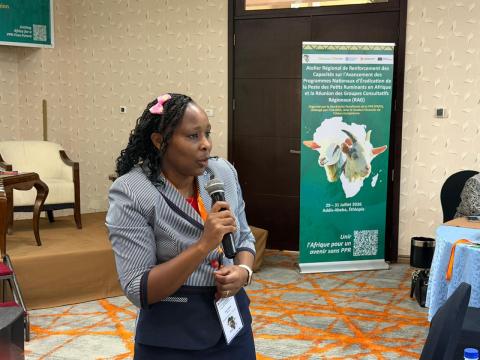
The Representative of he World Organisation for Animal Health (WOAH) highlighted that the workshop provides a strategic platform for countries to strengthen national PPR control programmes, maximise the use of the PPR Monitoring and Assessment Tool (PMAT) and advance towards WOAH endorsement of official PPR control programmes.
WOAH underscored "We have the political commitment. We have the technical tools. Now we need coordinated regional action, stronger national implementation and sustained investment to make a PPR-free Africa a reality."
Day 1 focused on reviewing progress made by Member States, challenges encountered, identifying implementation bottlenecks, strengthening evidence-based surveillance and vaccination strategies, and reinforcing regional coordination to accelerate progress towards #PPR.
Together, African countries and partners are turning commitment to PPR eradication into coordinated action to protect livelihoods, strengthen food security, improve animal health and build a more resilient and sustainable livestock sector."