

Putting Animal and Forage Seed at the Heart of Africa’s Seed Agenda
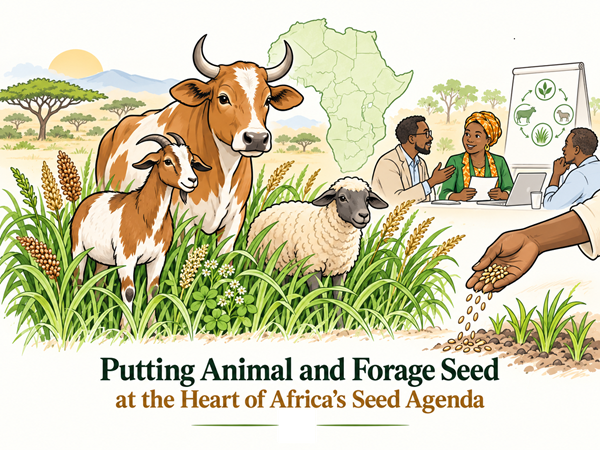
AU-IBAR side event at the African Union Inaugural Seed Summit calls for an integrated animal and forage seed system for climate-resilient livestock
Ezulwini, Eswatini, 6 October 2026. Africa’s seed agenda cannot succeed without livestock. The African Union Inter-African Bureau for Animal Resources (AU-IBAR) convened a side event at the African Union Inaugural Seed Summit to deliver this central message. The Summit took place at the Palazzo Convention Centre in Ezulwini, Eswatini, from 5 to 7 October 2026.
The side event, themed “Animal Genetic Resources as Strategic Seed for Climate-Resilient African Livestock Systems”, was organised with the International Livestock Research Institute (ILRI) and the Eswatini Department of Livestock. It brought together 24 participants from Eswatini, South Africa, Namibia and Zambia. They included livestock and crop farmers, livestock and seed experts, policy specialists and private-sector actors.
Dr Florence Nherera-Chokuda, Senior Livestock Policy Advisor at GIZ, facilitated the session on behalf of AU-IBAR and its Technical Working Group. Prof S. Dube co-facilitated for ILRI.
Why animal and forage seed matter
Africa’s indigenous livestock breeds, planted forages and natural rangelands are strategic assets. They carry traits for climate resilience and disease tolerance. They also sustain the food security and livelihoods of millions of farming and pastoral households.
Yet these resources remain largely outside mainstream seed policy and investment. Participants pointed to fragmented seed value chains, weak quality assurance and poor traceability. Access to reproductive technologies is limited. Above all, seed systems on the continent remain biased towards crops.
To address these gaps, the side event set out three linked resource domains:
-
Animal seed: breeding animals and reproductive genetic material for all livestock, including fish and bees, supported by structured breeding and genetic evaluation.
-
Planted forage seed: improved pasture and forage grasses, legumes, fodder crops, trees and shrubs.
-
Rangeland seed: indigenous grasslands and natural grass and tree resources that serve as climate-resilient forage banks.
All three are under growing pressure. Weak conservation, indiscriminate breeding, uncontrolled crossbreeding and breed replacement are eroding them. In addition, systems for evaluation, multiplication, certification and farmer access remain inadequate.
From recognition to implementation
Participants agreed that the problem is not a lack of policy recognition. The Africa Seed and Biotechnology Programme (ASBP) Action Plan and the CAADP framework already recognise livestock and animal genetic resources. The task now is to turn that recognition into implementation, investment and reporting.
Current reporting on animal seed performance, genetic evaluation, certification and forage resources is limited. As a result, investment decisions and accountability lack a sound evidence base.
The Summit itself opened a door. At high political level, animal genetics and plant seed systems were recognised as complementary parts of Africa’s food sustainability agenda. This gives AU-IBAR and its partners a firm platform to strengthen the animal and forage dimensions of the continental seed agenda.
Key outcomes
The side event agreed on three practical recommendations:
-
Embed animal, forage and rangeland seed in the ASBP. The revised ASBP and the post-Summit implementation roadmap should explicitly cover animal genetic resources, planted forage and rangeland seed systems.
-
Operationalise the Animal Seed Technical Working Group. AU-IBAR will convene and coordinate the group as a practical platform for policy, standards, technical tools, investment and stakeholder engagement.
-
Strengthen the Regional Centres of Excellence. Investment is needed in the five Regional AU Animal Resources Seed Centres of Excellence in Botswana, Burkina Faso, Cameroon, Tunisia and Uganda. The centres will support skills development, genetic evaluation, cryopreservation, performance reporting and reproductive technologies.
Participants also called on the African Union Commission (AUC) to recognise and approve the concept note for the proposed AU-IBAR Livestock Summit 2028. The summit would provide a continental platform to build a coordinated African animal and forage seed system. It would also strengthen the ASBP Technical Working Groups on Animal Seed and Forages by clarifying each partner's roles. AU-IBAR would lead on policy, coordination and implementation. ILRI and research partners would provide science, technology and innovation.
As a direct output of the side event, AU-IBAR will publish a policy brief on Africa Animal Seed Systems.
AU-IBAR, as the AUC's specialized technical office, focuses on leveraging animal resources for human well-being and economic growth in AU Member States. The recent outcomes align with this goal, positioning AU-IBAR as a leader in animal genetic resources and livestock seed systems. These outcomes contribute to multiple frameworks, including Agenda 2063 by promoting inclusive growth and sustainable development, aiding CAADP's actionable livestock initiatives, enhancing the Livestock Development Strategy for Africa (LiDeSA) in productivity and investment, integrating animal seed within the Africa Seed and Biotechnology Programme, and supporting climate resilience through the promotion of indigenous breeds.
The way forward
The message from Ezulwini highlighted that animal and forage seed systems are integral to Africa’s food security, livestock transformation and climate resilience. The immediate opportunity is to make them a defined pillar of the revised ASBP, with AU-IBAR providing continental technical leadership through the Animal Seed Technical Working Group.
This approach will connect genetic conservation, breeding, forage systems, quality assurance, digital technologies and regional cooperation. Crucially, it will keep farmers and pastoralists at the centre as owners of the continent’s genetic and natural resource wealth.