

Strengthening Africa’s Voice in Global Fisheries, Biodiversity and Climate Fora
Africa’s fisheries, aquaculture and aquatic ecosystems are central to food security, livelihoods, trade, climate resilience and sustainable development. Yet, the continent’s ability to benefit from these resources depends not only on national and regional action, but also on how effectively African countries participate in global decision-making processes that shape rules, commitments and opportunities.
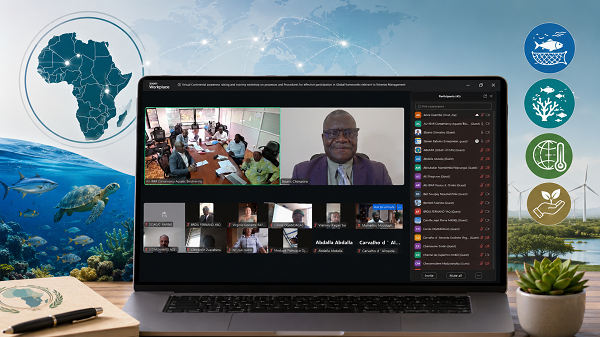
It is against this background that the AU-IBAR convened the Continental Virtual Expert Training Workshop and Awareness Raising for African Union Member States and other Stakeholders on Processes and Procedures for Effective Participation in Global Fora relevant to Fisheries Management, Aquatic Biodiversity Conservation, Climate Change and Environment Management, held virtually from 11 to 12 May 2026.
The meeting, organised with support from the Swedish International Development Cooperation Agency (Sida) and in collaboration with the Policy Research Network for Fisheries and Aquaculture in Africa (PRNFAA), brought together representatives of African Union Member States, Regional Economic Communities, regional institutions, African Union Centres of Excellence, partners, non-state actors, civil society organisations, and the private sector.
The workshop responded to a clear continental priority: strengthening Africa’s capacity to engage effectively, consistently and strategically in global fora that influence fisheries management, aquatic biodiversity conservation, climate change and environmental sustainability.
In her opening remarks, Dr Huyam Salih, Director of AU-IBAR, emphasised the importance of collective engagement across the continent. She noted that Africa’s aquatic ecosystems provide “substantial benefits to the continent, in terms of employment, income and contribution to food security,” but cautioned that unsustainable exploitation continues to threaten biodiversity, natural resources and environmental sustainability.
Her message reinforced the urgency of the workshop: Africa must not only participate in global discussions but also do so with strong technical preparation, coordinated positions, and a clear understanding of the processes that shape global decisions.
The workshop was anchored in AU-IBAR’s mandate as a specialised technical office of the African Union Commission under the Department of Agriculture, Rural Development, Blue Economy and Sustainable Environment. Its work in fisheries, aquaculture and the Blue Economy is guided by the Policy Framework and Reform Strategy for Fisheries and Aquaculture in Africa and the Africa Blue Economy Strategy, both of which seek to advance food security, livelihoods, wealth creation and sustainable economic transformation.
Dr Salih recalled that the Africa Blue Economy Strategy, endorsed by African Union Heads of State and Government in 2020, provides a continental blueprint for harnessing Africa’s aquatic resources in an inclusive and sustainable manner. This strategy recognises the Blue Economy as a major pathway for Africa’s socio-economic transformation, particularly through fisheries, aquaculture, ecosystem conservation, maritime governance, climate resilience and sustainable use of aquatic resources.
A key feature of the meeting was its focus on turning continental policy into practical capacity. Under the Sida-supported project “Conserving Aquatic Biodiversity in African Blue Economy,” AU-IBAR commissioned studies that identified 21 key global fora relevant to Africa’s participation. These studies led to the development of a mechanism to enhance Africa’s common position through the effective participation of African Union Member States in global fora on aquatic biodiversity conservation and environmental management. The mechanism was endorsed by the Summit of African Heads of State and Government in 2024.
This endorsement gives the initiative strong political significance. It means the workshop was not an isolated training activity, but part of a broader continental effort to improve Africa’s preparedness, coordination and influence in global policy spaces.
Over the two days, participants were taken through key processes and procedures for effective engagement in selected global frameworks, including the Food and Agriculture Organisation Committee on Fisheries, the International Commission for the Conservation of Atlantic Tunas, the Convention on International Trade in Endangered Species of Wild Fauna and Flora, and the United Nations Framework Convention on Climate Change.
The agenda combined technical presentations, interactive discussions, and experience sharing. Day one focused on fisheries-related global fora, while day two addressed multilateral environmental agreements relevant to biodiversity conservation, climate change and environmental management. The sessions were facilitated by AU-IBAR experts and Dr Sloans Chimatiro, International Consultant and President of PRNFAA.
The workshop made an important contribution by helping participants understand not only the content of global agreements and fora, but also the procedures, timelines, negotiation spaces and opportunities through which African Union Member States can advance common priorities. This is critical because effective participation requires more than attendance. It requires preparation, evidence, coordination, negotiation skills and follow-up.
The meeting also emphasised the importance of building institutional memory. Global processes are often technical and complex, and countries can lose influence when knowledge is fragmented or when participation depends on individual experience rather than structured systems. By strengthening awareness, documenting lessons and promoting a coordinated African voice, the workshop contributed to a more sustainable approach to continental engagement.
The expected outcomes included enhanced capacity among African Union Member States, improved understanding of global processes and procedures, documented lessons and best practices, and practical recommendations to strengthen Africa’s participation and common voice in global frameworks.
The timing of the workshop was also significant. Dr Salih drew attention to the forthcoming 11th United Nations Ocean Conference, to be hosted by Kenya from 16 to 18 June 2026 under the theme “Our Ocean, Our Heritage, Our Future.” She noted that the conference would provide an important platform for governments, regional bodies, private-sector actors, and communities to reaffirm their commitment to sustainable ocean governance and the conservation of aquatic biodiversity.
This connection gave the training added relevance, as African countries prepare to engage in major global discussions on ocean governance, biodiversity and sustainability.
In closing, the representative of AU-IBAR’s director thanked African Union Member States, regional institutions, stakeholders, the Government of Sweden and the international consultant for their support and participation. She expressed appreciation for the collaboration that continues to strengthen institutional capacity for the integrated governance of aquatic ecosystems and wished participants “successful, interactive and fruitful deliberations and outcomes.”
The impact of the meeting lies in its practical and strategic contribution. It strengthened knowledge, built confidence, encouraged coordination and reinforced the need for Africa to speak with clarity and purpose in global fora. More importantly, it advanced the continental shift from participation to influence.
Through this initiative, AU-IBAR reaffirmed its role as a continental convener, technical partner, and knowledge broker in supporting African Union Member States in engaging more effectively in the global processes that shape the future of fisheries, aquatic biodiversity, climate action, and the Blue Economy.