

Turning Feed Data into Opportunity for Cameroon’s Livestock Transformation
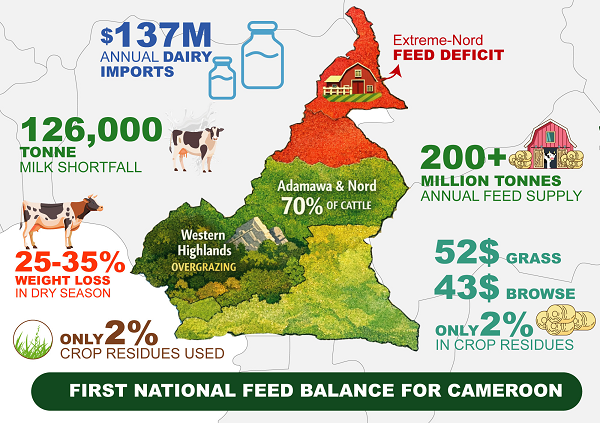
Cameroon's livestock sector is essential to the national economy, accounting for more than 40% of agricultural GDP. However, until recently, sector decisions were made without a clear, quantifiable understanding of feed availability, which is the most important input for livestock productivity. Cameroon's first-ever National Feed and Fodder Inventory and Balance is thus a significant milestone, offering a strong evidence base to guide policy, investment, and sector growth.
What the Data Shows
At first glance, Cameroon appears to have sufficient feed resources. The country produces over 200 million tonnes of feed (dry matter) annually, and most regions show an overall feed surplus . However, this national picture hides important challenges.
Feed resources are not well utilized:
- 52% of feed comes from grass and 43% from browse
- Only 2% comes from crop residues, despite their wide availability on farms
This means that a large share of potential feed, such as crop by-products is currently wasted instead of being used productively.
The Challenge of Seasonal Feed Shortages
The most important finding is that feed is not available when it is most needed. During the rainy season, there is plenty of forage. But because there are no strong systems for conserving feed (such as hay or silage), this abundance does not carry over into the dry season.
As a result:
- Livestock in northern regions lose 25–35% of their body weight during the dry season (February–April)
- Productivity declines, affecting milk production, growth, and survival rates
This shows that the problem is not overall supply, but poor storage, conservation, and distribution of feed.
Regional Differences Matter
The analysis also highlights important regional differences:
- Adamawa, Nord, and Bénoué have strong potential for feed production and hold most of the country’s cattle
- Extrême-Nord faces a clear feed deficit, due to low rainfall
- Western Highlands are under pressure from overgrazing and land degradation
These differences mean that solutions must be targeted to specific regions, rather than applied uniformly across the country.
Why This Matters for the Economy
Feed availability is directly linked to national development goals. Cameroon:
- Imports over US$137 million worth of dairy products annually
- Faces a milk deficit of about 126,000 tonnes
- Aims to reach 1.15 million tonnes of milk production by 2035
Achieving these targets will not be possible without improving feed systems. In simple terms, no feed means no livestock productivity.
The Importance of This Exercise
This feed balance exercise implemented by AU-IBAR and ILRI with the Government of Cameroon is important because it:
- Provides clear, reliable data for decision-making
- Identifies where investments are most needed
- Highlights opportunities to reduce imports and increase local production
- Supports better planning for climate resilience and seasonal shocks
- Creates a basis for regular monitoring of the livestock sector
The Way Forward
The findings point to practical actions that can transform the sector:
- Invest in fodder production, especially in high-potential northern regions
- Promote feed conservation (hay and silage) to address dry-season shortages
- Improve the use of crop residues, which are currently underutilized
- Support the growth of a local feed industry
- Update the feed balance regularly to guide planning and investment
In summary, Cameroon does not lack feed resources, but lacks systems to manage them effectively. This exercise provides the evidence needed to change that. By acting on these insights, Cameroon can strengthen its livestock sector, reduce imports, and improve food security and livelihoods.