

Zimbabwe Advances a US$25 Billion Feed and Fodder Strategy to Transform Livestock Systems
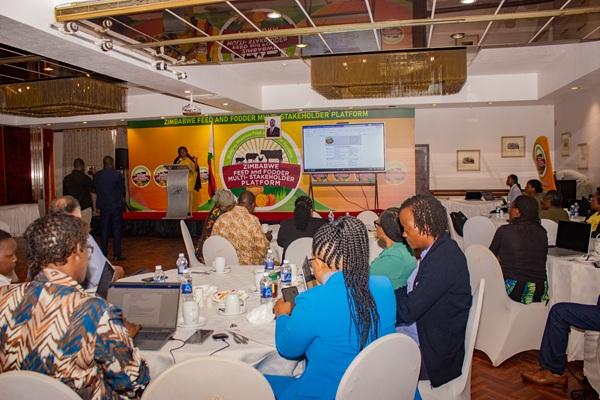
Harare, Zimbabwe – The Zimbabwe Feed and Fodder Multi-Stakeholder Platform (ZFF MSP) convened a high-level partners’ breakfast meeting in Harare last week to launch its strategic vision for transforming the country’s livestock sector into a globally competitive, climate-resilient and nutrition-responsive industry, anchored on an emerging US$25 billion feed and fodder economy. The event brought together a broad coalition of stakeholders, including representatives of the Ministry of Lands, Agriculture, Fisheries, Water and Rural Development, Dr. Sitokozile Sibanda – Director of Livestock Production and Development under the Directorate of Agriculture and Rural Development Advisory Services – who represented Professor Obert Jiri, partners from the African Union–Interafrican Bureau for Animal Resources (AU-IBAR), leaders of financial institutions, development partners, women’s agribusiness networks, and farmer organisations.
In his address, ZFF MSP Chairperson Dr. Makoni underscored that livestock sustains about 70% of rural livelihoods and contributes roughly 35% of Zimbabwe’s agricultural GDP, positioning feed and fodder as a foundational pillar of the national economy and rural welfare. He warned that the 2023–2024 El Niño-induced drought had placed an estimated 23 million cattle at risk due to a severe deficit in feed and fodder supply, with only around a third of national requirements being met, while feed costs account for almost four-fifths of dairy production expenses and have rendered many enterprises marginal or unprofitable. Against this backdrop, he presented the Zimbabwe Feed and Fodder Multi-Stakeholder Platform as the country’s unified response, built on three core pillars: coordination through a formal Trust under the Livestock Meat Advisory Council to harmonise efforts; resilience to shift from reactive crisis management to long-term systems building; and professionalisation to standardise feed and fodder markets, reduce transaction and production costs, and guarantee quality inputs for farmers across value chains.Se
Dr. Makoni explained that the Platform emerged under an AU-IBAR-led continental initiative responding to global disruptions such as COVID-19, climate shocks and conflicts, designed to strengthen feed and fodder systems, productivity, and climate resilience in six pilot countries. Zimbabwe joined this initiative in May 2024 as the fifth pilot country alongside Kenya, Cameroon, Uganda, Somalia and Nigeria, and has since made notable progress in institutionalising the Platform. Key achievements to date include the development of a 2025–2030 strategic plan to guide action and investment, initiation of the legal registration of the ZFF MSP Trust, allocation of office space by the Ministry within the veterinary services department, provision of IT equipment support through the RAFS project, and the launch of a media campaign to raise public awareness and stakeholder engagement around feed and fodder as a strategic economic and food systems issue. He emphasised that the overarching ambition is to unlock a US$25 billion livestock-driven economic opportunity by lowering production costs, improving the quality and availability of feed and fodder, and scaling productivity across beef, dairy and other livestock sectors to enhance both export competitiveness and domestic nutrition outcomes.
Representing AU-IBAR and the broader continental feed and fodder agenda, Dr. Sarah Ashanut Ossiya highlighted the central role of livestock-sourced foods in human capital formation, national productivity and long-term economic growth. She drew attention to persistent nutrition challenges in Africa, including high levels of child stunting and widespread nutrient deficiencies that diminish learning outcomes, innovation, and labour productivity, and noted that livestock-derived foods are uniquely nutrient-dense and bioavailable, yet remain unaffordable for many households and therefore treated as a luxury despite being a necessity. Dr. Ossiya underscored a structural paradox: Africa holds a significant share of the world’s livestock resources, including a large proportion of global ruminants, but contributes only a small fraction of global feed resources and meat output, revealing both a systemic gap and a major opportunity for targeted investment and policy reform. She described the feed and fodder sector as one of the fastest-growing agricultural segments globally and set out key principles for its development, including treating livestock products as a universal market, rapidly scaling the sector through end-to-end contracting that links feed supply to production targets and market demand, mobilising upstream and blended finance to de-risk investments, institutionalising robust data and digital analytics for agile decision-making, adopting a new language and communication approach that reflects the sector’s true economic weight, and investing in both large-scale infrastructure and the vast informal ecosystem that underpins rural livelihoods.
In the main policy address, delivered on behalf of Permanent Secretary Professor Obert Jiri by Dr. Sitokozile Sibanda in her capacity as Director of Livestock Production and Development under the Directorate of Agriculture and Rural Development Advisory Services, the Ministry situated the ZFF MSP squarely within Zimbabwe’s economic transformation and Vision 2030 agenda. The address reiterated that agriculture contributes roughly 9–12% of national GDP, employs between 60–70% of the population, and supplies more than 60% of raw materials to manufacturing, while the livestock sub-sector supports about 70% of rural households and is fundamental to food security, employment creation and poverty reduction.
 |
 |
Dr. Sibanda, on behalf of the Permanent Secretary, acknowledged the severity of the 2023–2024 El Niño-induced drought, ongoing fragmentation in coordination, and gaps in policy and regulatory frameworks, as well as the long-term existential threat posed by climate change to Zimbabwe’s livestock systems. In response, she outlined the Ministry’s focus on strengthening the policy and regulatory environment for feed and fodder, including the development of comprehensive regulations, and promoting climate-smart production practices such as the uptake of drought-tolerant fodder crops and the strategic unlocking of water infrastructure. She emphasised that the country’s stock of more than 10,000 dams and some 35,000 rural boreholes represents a substantial opportunity for irrigated fodder production and year-round resilience if effectively harnessed and coordinated through platforms like the ZFF MSP. The Platform was presented as a registered national asset and operational hub for collective action, tasked with unifying stakeholders to overcome fragmentation, align investments, and drive both commercialisation and export growth in line with global standards.
The address further highlighted the opportunities presented by the African Continental Free Trade Area (AfCFTA), noting that a well-coordinated and competitive feed and fodder base can enable Zimbabwe to transition from a traditional “food basket” identity to a regional agro-processing and livestock hub serving wider African markets. Ambitious targets were shared, including increasing the national cattle herd to around 6.6 million and boosting broiler production to approximately 362 million birds, all anchored on a secure, efficient and sustainable feed and fodder system capable of supporting intensified and market-oriented livestock production. Throughout the meeting, speakers called for scaled-up investment from financial institutions, private sector actors and development partners to fund the ZFF MSP strategic plan, with particular emphasis on inclusive financing models that ensure at least half of mobilised resources support women and youth, who constitute a large share of the agricultural labour force, and that all interventions are underpinned by climate resilience and digital innovation.
The Platform was ultimately framed as a covenant among government, private sector, financiers, development partners, research and academic institutions, civil society and farmers, underpinned by a strong and responsive policy environment and a shared determination to build a competitive, resilient and nutrition-sensitive livestock sector that advances Zimbabwe’s Vision 2030 of a prosperous and empowered society. As the partners’ breakfast drew to a close, participants reaffirmed their commitment to using the ZFF MSP as a vehicle for structured dialogue, joint investment and coordinated implementation, and to working collectively towards the emergence of a dynamic US$25 billion feed and fodder economy that safeguards rural livelihoods, strengthens national food and nutrition security, and positions Zimbabwe as a regional leader in livestock production and value addition.